Cross-Platform Data Handling from UI to I/O
Ease your development efforts with Qt's out-of-the-box, cross-platform data handling capabilities. Efficiently send, receive, save, load, query, manipulate, and serialize data, scaling across your application's architectural layers.
Data Handling Across Architectural Layers
Qt's cross-platform capabilities allow efficient data handling with data serialization, use of well-known formats, and versatile data input and output (I/O). The simple and powerful concepts allow implementation across your application's architectural layers and re-use from platform to platform.
Single API for All Platforms
Take away the effort to maintain your setups for different platforms with only one source code.
Out-of-the-Box Capabilities
Handle I/O to and from networks, devices, databases, files, settings, and resources, and serialize data as needed.
See Qt's Data Handling CapabilitiesVarious Standards & Formats
Enable interoperability with well-known formats such as XML, JSON, CBOR and Protobuf.
One doesn't need to care of all the boilerplate underneath and is 100% sure that the design behind is the best achievable.
Alessandro Agansati, Project Leader Pitstop System, Sauber Motorsport
CROSS-PLATFORM EFFICIENCY
Data Handling from Platform to Platform
Take away a lot of your routine work with a single API for all your data handling needs. It works the same for all platforms, easing the burden of managing your application logic separately for various operating systems.
Qt comes with a range of data input and output (I/O) capabilities that also scale from high-level to low-level APIs. You’ll only have one source code to write and maintain for all your application’s data handling needs.
OUT-OF-THE-BOX BUILDING BLOCKS
Support for Various Standards & Formats
Qt’s ready-made capabilities support a range of standards & formats for efficient and compatible data handling.
Use serialized data and well-known formats for, for example:
- Efficient data transfer via e.g. web services, gRPC, and other networking & connectivity options,
- Data persistence for e.g. caching and storage,
- Processing especially large amounts of data.
Setup data I/O to and from various sources, such as:
- External device or database input and output,
- Touchscreen, keyboard, microphone or webcam input,
- Monitor, speaker, printer, or rendering 3D output.
With Qt, it’s all readily available for cross-platform use.
Qt’s Data Handling Capabilities
Qt provides classes for ensuring interoperability with data serialization and handling data input and output (I/O).
Interoperability
Facilitate data handling with standardized data structures.
Data Serialization
The Qt APIs enable data serialization for, for example:
- Easily parsing, modifying and saving JSON data,
- Serializing binary data to hardware devices,
- Handling C++ implementations of XML data.
Well-Known Formats
Qt provides easy-to-use classes for various well-known formats, depending on your needs:
- The human-readable XML or JSON
- The compact, machine-readable CBOR or Protobuf
Couple these up with Qt’s versatile networking & connectivity capabilities for more interoperability building blocks.
Saving and Loading
Save, load, and manipulate data in networks, devices, databases, files, settings, and resources.
With Qt, you can easily set up access and queries, as well as reading and writing for various data sources. You can also read and write text as words, lines and numbers, and store strings, for example, for saving special characters needed in localizations for different languages.
When dealing with specific file format requirements, you can use utilities to allow development in your original representation.
For application performance, Qt has classes for cross-platform application settings and resources, and intermediate data storing to reduce read and write operations for speeding up your application.
Qt plays a central role in resource management and multi-threaded stability, ensuring reliability and scalability in our development environment.
Seonggong Moon, Head of Product Development, Oncosoft
1000s of Developers Use Qt
More on Data Handling
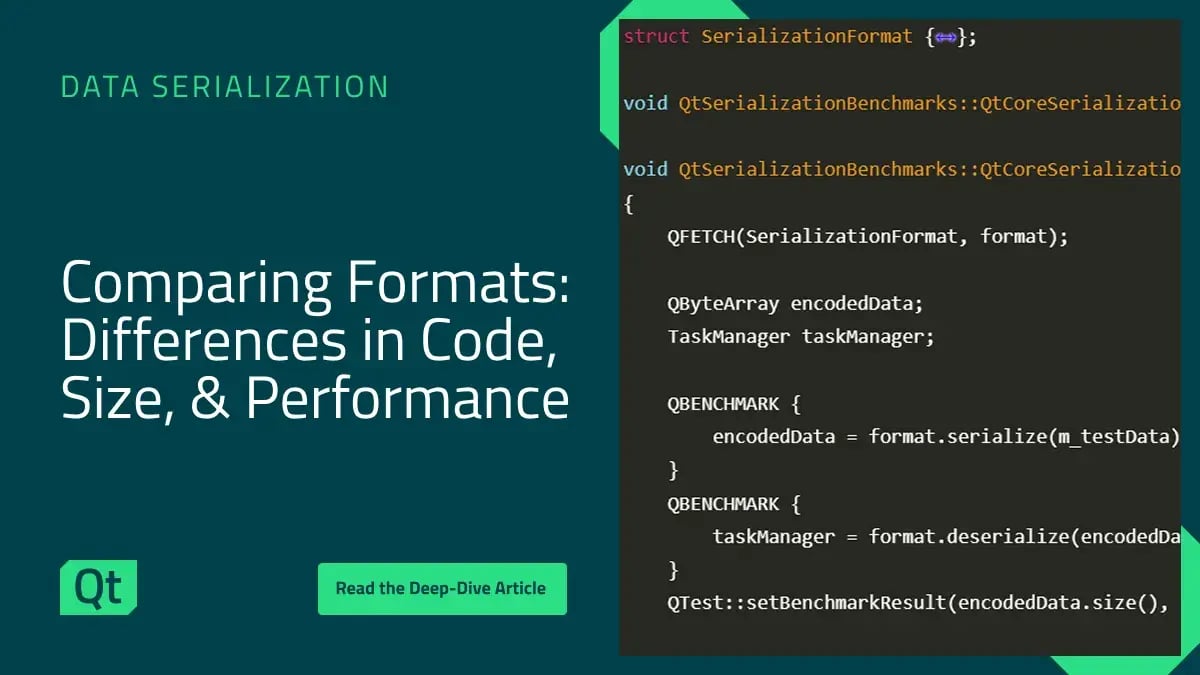
Comparing Data Serialization Formats: Code, Size, and Performance
In this post, we explore different approaches for data serialization, ...
Qt CAN Bus API extensions
The latest Qt 6.5 release introduced a lot of new features. You can re...
How to Select the Right CPU or SoC for your Embedded Project
The central processing unit (CPU) or system on a chip (SoC) you choose...
More on Qt Framework
Qt Framework’s comprehensive set of libraries take away your routines from middleware to UI, 2D to 3D, platform to platform.
More on Releases & Licensing
The regular Qt Framework release cycle and the flexible licensing options allow you to choose the best fit to your product’s needs.
Get the Most out of Qt
Ease your development efforts with cross-platform data handling that scales across the architectural layers.