Easily Create Your Advanced Driving Assistance System with Qt Surrounding Reality HMI Template
Developed and actively maintained by Qt Group, Qt Surrounding Reality (SR) HMI Template delivers cutting-edge functionalities—such as lane detection, parking assistant, and traffic sign recognition—for OEMs to quickly ramp up their ADAS development with a fully customizable ready-made product.
A Cost-Effective Quick Start for Next-Gen Surrounding Reality Systems
Easily bring 360° situational awareness to your cars with Qt ready-made template
Bringing an SR HMI to production is a complex undertaking. Development must integrate diverse software components, including high-fidelity 3D models, adaptable UI layouts, scalable architectures, advanced interaction patterns, intricate driving-scene visualization, control logic, backend connectivity, performance optimization, and hardware-specific adaptations.
With Qt SR HMI Template, OEMs can accelerate their HMI development while keeping pace with the latest ADAS capabilities and ensuring long-term maintainability.
ADAS and Detection Systems
Building a modern surrounding reality ADAS requires strong expertise covering, among other things, computer vision, sensor fusion, AI, graphics and UI design, real-time embedded software, networking, and more.
With Qt SR HMI Template, OEMs are given a white-box code-base of ready-made, customizable ADAS functionality, such as:
- Target Detection for vehicles, pedestrians, and objects surrounding the vehicle
- Lane Detection and Planning Line to follow the optimal trajectory
- Traffic Light Assist and Traffic Sign Recognition to automatically recognize traffic lights and signs
- Automated Parking Assistant using radar sensor data
Key Features & Capabilities
Qt SR HMI Template is built in accordance with Qt principles of modularity, openness, and flexibility. Distributed as white-box source code, it allows OEMs to quickly ramp up their ADAS development by leveraging production-ready code that can be easily customized in look and functionality.
Modular Architecture
Flexibility, maintainability, and ease of integration through Data Adapter Layer, Data Source Layer, Model Layer, UI Layer
Multi-Source Data Integration
Support for diverse automotive data inputs, such as CAN bus, SOME/IP, and simulation feeds for compatibility with a wide range of vehicles and testing environments
Realistic Simulation Support
Built-in support for realistic sensor data simulation for accelerated development, testing, and proof-of-concept demonstrations—without dependency on physical vehicles
Layered Detection Architecture
Each detection capability (e.g., lane, target, TSR) operates as an independent system within a common architecture, for a clear separation of areas and targeted innovation
Real-Time Data Processing
The system transforms raw sensor data into actionable insights in real time, supporting features like target tracking, lane positioning, and traffic sign recognition
UI Integration via Dynamic Models
The system delivers processed data to the user interface using dynamic data models, ensuring smooth, up-to-date visual representation for drivers or operators
Technical Details
Qt SR HMI Template includes all QML source code divided into easily customizable modules. The layered architecture of the C++ backend enables neat separation and easy customization of the detection logic. Pre-recorded or mockup data streams use Protobuf format to simulate detection scenarios for UI integration.
OS
Qt Version
Modules Used
Hardware Used
Linux, Windows, MacOS
Qt 6.8 LTS
Qt Core, Qt Quick, Qt Quick 3D, Qt 5 Core Compatibility
Raspberry PI4, Qualcomm 8775
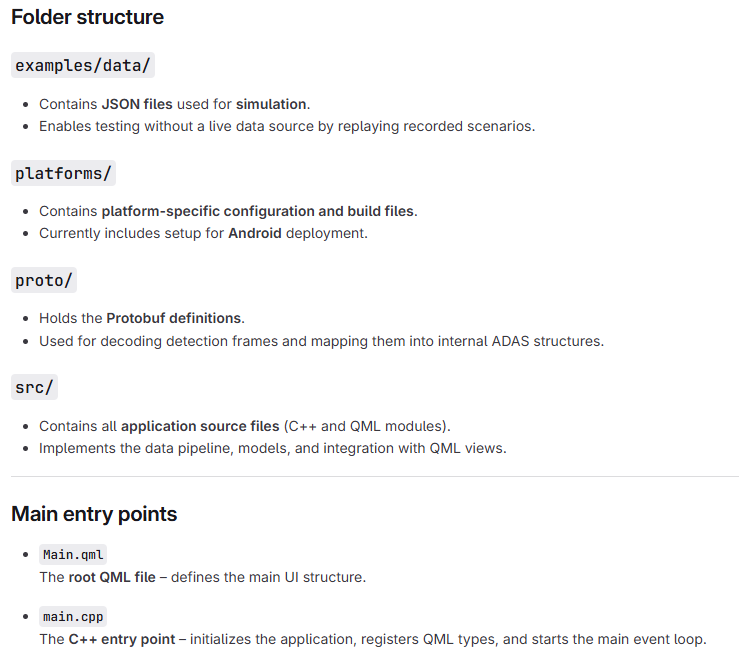
The package provides step-by-step instructions to set up the development environment and build the template, and an explanation of the project structure, including QML/C++ interactions.
Join Our Experts Presenting the Product
Join our Webinar
Package Content
Qt SR HMI Template is shipped as a code repository containing the main ADAS application. This integrates data ingestion, processing, and visualization through a modular C++/QML architecture. The project has the following clean layered architecture:
QML Views
Models
Data Sources
Data Adapters
QML-based visual presentation layer
Qt models for data binding
Data transformation layer
Data input abstraction
More Resources
Explore Qt Demos
From immersive 3D experiences to concrete industrial applications, our demos showcase the art of possible with Qt Group's technologies.
Qt Professional Services
Unlock Qt's full potential by leveraging the technical expertise and industrial experience of the core Qt developers.
Supported Hardware and Operating Systems
Check all Qt-supported platforms and readily available BSP.
Qt in Automotive
Create unique user experiences in your software-defined vehicles, using Qt's end-to-end tools for automotive HMI design, development, testing, and deployment.