
Build Deep Learning Applications with Qt and Tensorflow Lite - Dev/Des 2021
Only a few decades ago it seemed impossible to automatically classify bird species in images, let computers translate texts from German to English in a way that doesn't insult readers, or ask voice assistants for tomorrow's weather.
All these applications were enabled by the rise of Deep Learning. When it comes to state-of-the-art results in analyzing unstructured data - the kind of which you find in images, audio, or text - deep neural networks are the way to go.
Fortunately, together with progress in research, frameworks like Tensorflow and PyTorch emerged to ease development. It is now possible to download pre-trained models from the internet, fit them to one's need or just use them.
Tensorflow Lite is an inference framework that makes it possible to run such models on embedded hardware and mobile devices. Its C++ API makes it easy to integrate use cases like computer vision or keyphrase detection into applications written with Qt. In this talk, we explain the use of Tensorflow Lite with Qt and QML, and demonstrate how everything works fluently on low-level hardware such as the Raspberry Pi.
Oh, here is more

Webinar: The Cyber Resilience Act: What Waiting is Costing US Software Teams
Starting September 11, 2026, the EU Cyber Resilience Act (CRA) requires companies to report actively...
Watch Video
Video: The Making of The Outpace Project
Project Outpace – Qt's Reference Panoramic 3D Automotive Cockpit. Don't Choose Between The Design Yo...
Watch Video
On-Demand Webinar: CI/CD and Continuous Compliance of Embedded Software for Aerospace and Defense
Today, CI/CD for pure software products is well understood. But hardware dependencies and embedded d...
Watch Video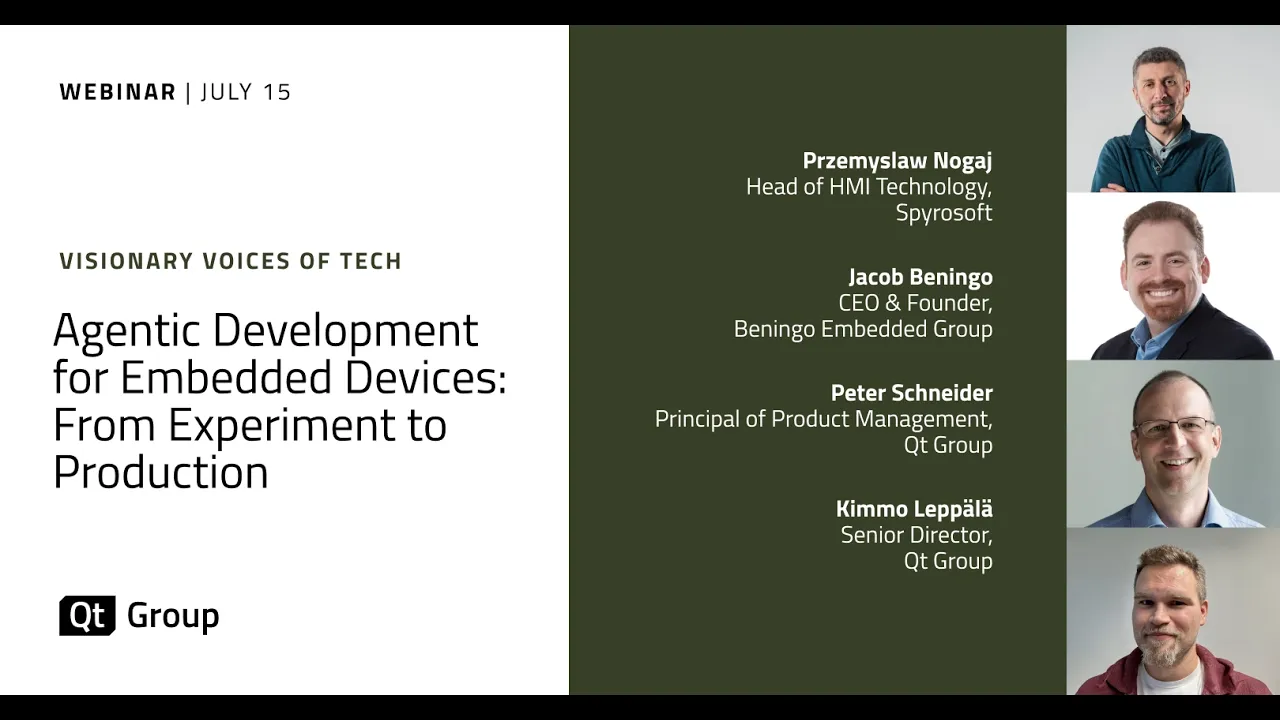
On-Demand Webinar: Agentic Development for Embedded Devices: From Experiment to Production
Agentic development for embedded devices is moving from experiment to production, and regulated indu...
Watch Video