Qt’s AI-Powered Development Tools
Agentic development is multiplying software engineering productivity. Qt's AI-powered development tools, MCP services and agent skills, give your agentic workflows the needed, deep Qt- and QML-specific expertise, especially powerful for developing cross-platform and embedded systems.
Multiply Your Productivity with AI-Powered Development Tools
Qt’s AI-powered development tools give your agents access to the Qt Framework -specific knowledge, context, and capabilities that generic LLMs often lack. Speeding up software development for target device across platforms, the dedicated MCPs and skills make available e.g. the needed context, hardware constraints, certification rules, and real-time system patterns. The result is faster software delivery without the back-and-forth of fixing AI code.
Faster Software Development
Focus on steering the development and let AI agents do the code writing, testing, and documentation.
High-Quality Agentic Coding
Make use of how well generic AI agents' already know Qt, further improved with dedicated MCPs and skills.
AI Toolchain Compatibility
Use Qt with leading agentic engineering tools, verified to follow open standards and frontier models.
CROSS-PLATFORM AGENTIC DEVELOPMENT
The Shift is Already Happening
Agentic development is transforming programming with productivity levels that no individual developer can match alone. Workflows for writing code, generating tests, and navigating projects are more and more executed by AI agents, however, we at Qt believe the human-in-the-loop remains, and should remain, the director of those workflows.
How Agentic Development Impacts Productivity: Examples
75-86%
Score by leading models on the QML100 benchmark for single-turn agentic tasks.
10×
Multiplied productivity from e.g. agentic documentation compared to mere AI-assistance.
30%
Of MCP token consumption cost compared to generic agentic web search.
THE OPEN SOURCE ADVANTAGE
Your AI Agents Already Know Qt
Qt's open source approach has allowed frontier models to learn from a wide variety of Qt C++ and QML pre-training material. Thanks to that, LLMs already know Qt way better than any closed-source framework.
-
Claude, GPT, and Gemini already score 75–86% on the QML100 benchmark for single-turn tasks.
- Ongoing reinforcement learning from human feedback (RLHF) allow fine-tuning the frontier models further.
- Dedicated MCPs and skills fill in the gaps where agents still fall short.
With all this, AI-powered development tools such as Claude Code and GitHub Copilot have a very strong foundation to generate high-quality Qt code.
Qt’s AI-Powered Development Tools: What’s Available Today
Where LLMs fall short without Qt-specific help, the provided MCP services and agent skills close those gaps efficiently. Developers can focus on improving the agentic workflows, keeping the human in the loop, and improving productivity especially for embedded development.
And we keep adding more all the time!
Agent Skills for Qt and QML
Agent skills are portable, version-controlled knowledge packages that give AI agents specialized Qt expertise. They work “on demand”, that is, they are loaded only when needed, allowing the agent's active context stay lean.
Where generic LLMs fall short without Qt-specific help, these agent skills help close those gaps efficiently.
More coming all the time!
Qt Code Review Skill
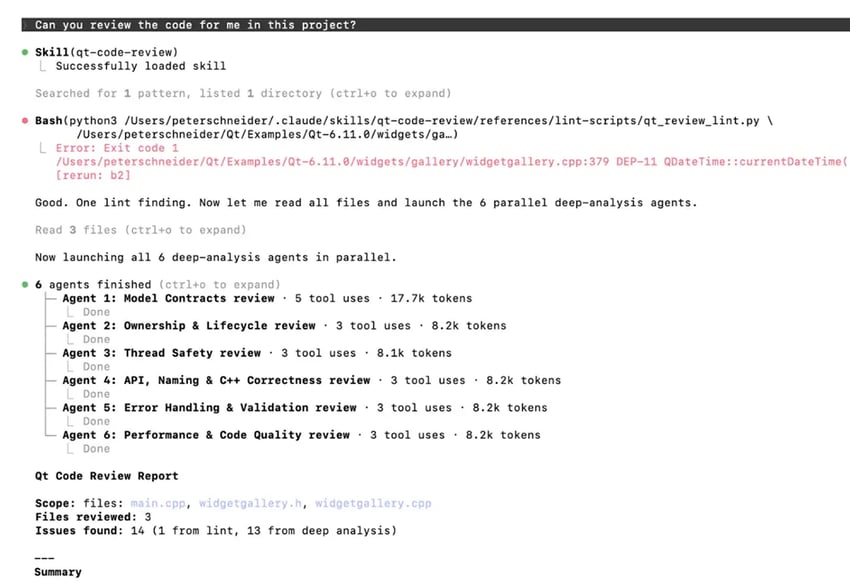
Removes the C++ and QML code review bottleneck of the AI era with linter instructions and subagents for deep code analysis, including thread safety, performance, and model rule compliance.
QML Coding Skill
Provides instructions for QML best practices, enabling AI agents for a higher-quality QML coding performance. Also significantly reduces token consumption from reduced online documentation research.
Qt Code Documentation Skill
Reduces the average C++ and QML code documentation effort for a Qt application from hours to minutes, also for complex projects.
Frequently Asked Questions
What is the difference between AI-assisted software development and agentic development?
- AI Tooling
- Agentic Engineering
AI-assisted tools like GitHub Copilot or Qt Creator’s AI Assistant suggest code while the developer executes every action. Agentic development goes further: AI agents autonomously plan, write, test, and iterate across a codebase. Productivity gains are massive for agentic development: while AI assistants deliver up to 10% gains at maximum, agentic solutions multiply engineering productivity.
What agentic development tools does Qt provide?
- AI Tooling
Qt currently provides two categories. Coming soon, MCP services that give AI agents access to Qt-specific capabilities where the first one out is the Qt Code Documentation MCP. Out already, agent skills which are portable, version-controlled knowledge packages for tasks like Qt C++ code review, unit test generation, and API documentation.
What is an agent skill, and why does it matter for Qt development?
- AI Tooling
An agent skill is a portable, version-controlled package that gives an AI agent specialised knowledge for a specific task. It’s loaded on demand, so the agent's context stays lean. For Qt developers, skills close the gap between a general-purpose AI agent and a dedicated Qt workflow, covering things like QML conventions, Qt testing patterns, and C++ code review. Because skills follow an open standard, they are portable across any compliant agentic development solution.
How does agentic development with Qt multiply productivity?
- AI Tooling
- Agentic Engineering
Qt's agent skills and MCP tools handle the tasks that consume developers' time but don't require their judgment, such as writing boilerplate code, test cases, API documentation, code review, and Qt-specific linting. This frees developers to focus on architecture, innovation, and the decisions that actually require human expertise.
Does Qt support agentic development?
- AI Tooling
- Agentic Engineering
Yes. Qt provides MCP-enabled tools and agent skills designed for agentic cross-platform development. Qt's open ecosystem also means frontier models such as Claude, GPT, and Gemini have trained on Qt’s C++ and QML code, with leading models already scoring 75–86% on the QML100 benchmark for single-turn tasks.
How does Qt compare to other UI frameworks for agentic development?
- AI Tooling
- Agentic Engineering
Qt's key advantage is training data depth. Decades of open Qt C++ and QML code means frontier models write better Qt out-of-the-box than they do for closed or less mature frameworks. Qt also covers a broader hardware range than alternatives, which typically target a single or limited types of target platforms or have not yet published dedicated agentic tooling or MCP integrations.
Does Qt support fully autonomous AI agents?
- AI Tooling
Not yet, and at Qt Group, we believe that's the right position especially for professional and regulated software development. The technology is not ready for fully autonomous agents. Qt's approach keeps the human in the loop as the director of workflows, using MCP tools and agent skills to close the gaps efficiently without removing oversight at critical checkpoints.
More on Qt Framework
Qt Framework’s comprehensive set of libraries take away your routines from middleware to UI, 2D to 3D, platform to platform.
Looking for Design Tools Instead?
Figma to Qt and Qt Design Studio bridge the gap between designers and developers, turning designs into production-ready QML code.
Get Started with Agentic Development
Get your Qt agent skills from our GitHub repository.