Aug 13, 2025
Comments
Qt Group is pleased to announce the latest Long Term Supported release of Qt for MCUs. The 2.11 release is concentrated on stability with fewer new features .
This blog lists some of the standout highlights from the 2.11 release and provides a roadmap of 2.x release for the rest of the year.
Geo Positioning: Offline Navigation
In an endeavour to bring native maps and navigation to microcontrollers, previously released Qt Location feature is now complemented with QtPosition Module and MapQuickItem. Geoposition APIs enable representation of an object on the map based on the device's current GPS position. This is the first step to assisting developers to implement a basic sense of direction and navigation in a map application. In addition to that, to place and locate a Position of Interest on the map the MapQuickItem is introduced.
These native maps and navigation building blocks will enable developing a navigation application with custom look and feel for micro-mobility and wearable use cases. Removing complete dependency on mobile devices, it will reduce distraction and battery consumption both for the phone and electric powered vehicles.
The map example is now updated with these features. Above is a simple example of a walking navigation. We have many more exciting features in store like Routing and Turn-By-Turn APIs which will be part of upcoming 2.12 release.
Efforts are being made to optimize this solution to Infineon Traveo T2G and other microcontroller platforms. A solution to update maps over-the-air dynamically to minimize on-board maps storage is being worked upon. Various map services are also analysed to make the solution scalable as per customer need.
Support For ESP-IDF : ESP32-S3
As part of Qt and Espressif collaboration the qmlprojectexporter now supports generating ESP-IDF projects for Espressif microcontrollers. ESP32-S3 mcu packages are now available from Qt online installer and it will be maintained hereafter. ESP-IDF integration allows developer to seamlessly bring in designs from Figma to a Espressif MCU through Qt provided Design and Development tools. Integrating MCU specific components to the HMI application is more simplified without the need of a static library approach or manual integration of software components.

A detailed guide is provided to describe the application flow to assist the development flow. In addition the Device Link protocol has also been implemented to enable Squish for MCUs to function seamlessly on this platform. This integration allows Qt for MCUs to easily scale to other newer platforms like ESP32-P4.
Release Roadmap Update
Since the release of 2.x in December 2021 Qt for MCUs has come a long way in improving the usability, stability of this framework. It is time to explore new way of doing things and break some APIs in order to improve the usability further. A decision has been taken to move to 3.x from 2026 and say adieu to 2.x with the last release 2.12 LTS planned by end of 2025. 3.0 will be a fully CRA compliant release which helps product makers to align with CRA deadlines.
However for 2.x and earlier users will have an option to opt for Extended SUPPORT and Extended Security Maintainance packages offered by Qt Group.
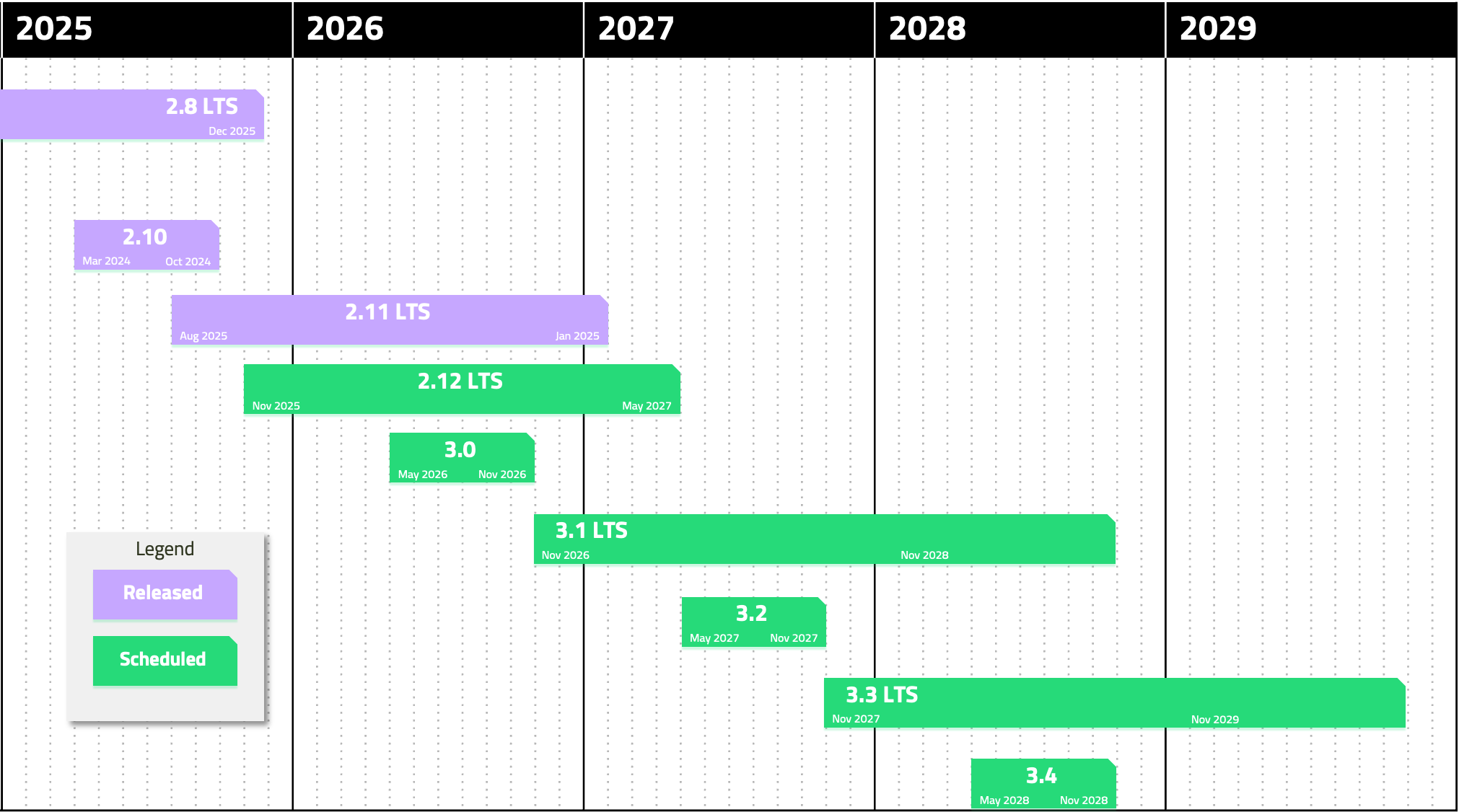
As a welcome update 3.x LTS lifetime will span over 2 years compare to 1,5 yrs currently and every second release will be a LTS. The above timeline is subject to change if there is a strong reason to do so.
And more!
LetterSpacing support is added as the font property for both Text and StaticText. This gives more convenience to the developer working with fonts.
Renesas EK-RA8D1 port is now officially out of Technical Preview with FreeRTOS, external flash support and bunch of improvements which makes this a production ready platform.
New Platforms : Qt for MCUs now supports STM32H7S78-DK and Renesas RA8P1 devices. Please reach out to Qt Group to request evaluation.
Qt Washing Machine Concept
A intuitive washing machine GUI concept developed as a reference for our consumer electronics customers representing a state-of-the art modern GUI. This will be added to the standard demos distributed as part of Qt for MCUs release package.
What's Next
As mentioned above the next and last release of 2025 and 2.x will be Qt for MCUs 2.12 LTS in November. The main highlights will be:
- Qt BLE: To make Qt for MCUs applications more portable for IoT, Edge as well as micro-mobility use cases, cross-platform BLE convenience APIs will be introduced.
- Qt Navigation: Qt Location's Navigation feature will be further enhanced with Turn-By-Turn and mcu specific end-to-end solution
- SBOM generation: Software Bill-of-Material generation will be enabled as a building block to full CRA compliancy in 2026.
- GCC13 and LLVM Support : An upgrade to arm-GCC 13 and support for LLVM compiler would be explored to enable helium support on M85 arm cores.
- AUTOSAR port for Infineon TRAVEO T2G: A FuSa ready integrated solution of Qt for MCUs and Qt Safe Monitor will be available on Vector Microsar stack.
- Tech Previews! - The following features are available on request and will be part of 2.12
-
Translation data (Internationalisation) is configurable now to store them at custom memory locations.This will help update translation data dynamically compare to present configuration which is part of the main binary.
-
Multi-Line Text Elide is also available now which helps to accommodate multiple lines in constraint text boxes.

-
A comprehensive list of changes in this version can be found in the changelog. All 2.11 features can be installed through 2.11.1 patch release version in the Qt Online Installer.
Deploy Qt for MCUs 2.11 now for optimized embedded applications
If you already use Qt for MCUs, you can download version 2.11 from the Qt Maintenance Tool in your installation folder. If you're new, click here to start. The new features and improvements are designed to add value to resource constrained embedded systems. Please share feedback and requests in the comments!
Blog Topics
Related Articles

Qt AI Assistant Retires As We Invest in Agentic Development Tools
The Way Developers Use AI Has Changed When Qt AI Assistant was introduced,..
Read Article
Qt Extension 1.16.0 for VS Code Released
We're excited to announce the release of version 1.16.0 of the Qt..
Read Article
Qt Safe Renderer 2.2.0 Released and Certified!
We are happy to announce the release and certification of Qt Safe Renderer..
Read Article