Dec 15, 2025
Comments
Qt Group is pleased to announce the latest Long Term Supported release of Qt for MCUs 2.12 LTS. As communicated earlier this would be the final release of 2.x series, before we welcome 3.0 in 2026! This release concentrates more on performance and stability so that users and customers can base current projects on this release for a long term before migrating to 3.x.
This blog highlights some of the standout features from the 2.12 release and provides a sneak peak at 3.0 and other exciting stuff we are working on.
Glyph layout cache = 2x improvement
A major improvement has been introduced in the way Glyph layout is handled by introducing a glyph layout cache that eliminates redundant layout passes by caching shaping and layout results at the paragraph level. This handles text-layout in a smarter way by removing repeated rendering passes and greatly improving the FPS, especially when complex script based fonts are involved in a text layout. As per our experiments we see more than 100% performance improvements in a very text layout intensive application.
The text cache still provides the most significant overall performance gain, while the glyph-layout cache specifically improves performance in applications that frequently re-layout dynamic text, which is typical in consumer electronics products like Printers, Oven displays.
For more details, please check out Qt for MCUs font rendering documentation.
FuSa support with QSR 2.2 Release on Infineon TRAVEO T2G
Qt for MCUs has now completed integration with FuSa-compliant Qt Safe Renderer module and is officially out of Tech preview. The implementation is now tested and validated with latest release of QSR 2.2 on Infineon Traveo T2G CYT3DL variant. The solution is due for certification.
A key improvement is the hardware accelerated safe items rendering, combining performance with compliance. At the same time, the overall integration has been streamlined in a way that developers no longer need to manually add safe resources, which are automatically handled by the tooling during application development.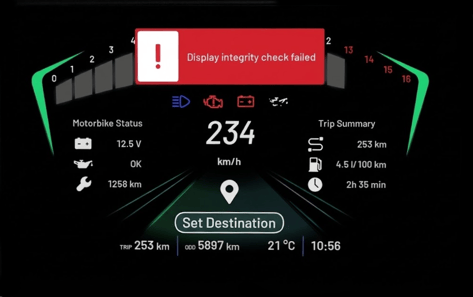
A set of configuration parameters has been introduced to achieve this automatic management of safe items and assets. Refer to the qmlproject and safety-critical UI development manual for more details. An example application is also provided as part of the QSR release to demonstrate this integration.
Please refer to official Qt Safe Renderer 2.2 release post to know more in details.
Convenient update with more configurability
Products are increasingly software-driven than the underlying hardware, and consumer expect periodic updates to the software. Qt for MCUs has now started placing a mechanism in place to decouple the critical/static parts of the software from the more configurable and dynamic visual elements. One of the features in this series is to be able to configure a specific memory location for translation data conveniently. This helps to configure a product for different languages with region specific localisation instead of storing complete set of font data in one-go saving considerable amount of resource on the microcontroller. Over-The-Air update also become much more convenient with connected platforms.
MCU.Config.translationStorageSection parameter is introduced in qmlproject configuration to achieve this feature seamlessly.
In the future, more dynamic properties will be introduced to Qt Quick Ultralite that can enable configuring the look and feel conveniently with minimal updates achieving a truly software defined products.
Zephyr support updates
Qt for MCUs now supports Zephyr OS version 4.1. All the supported Tier-1 platforms are updated and validated with this version.
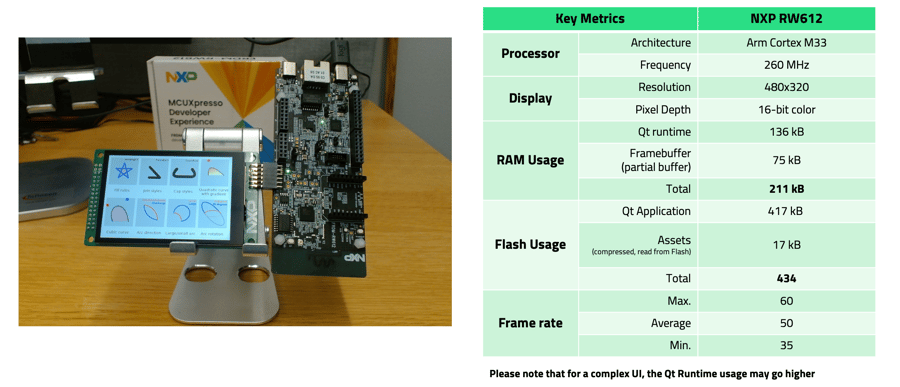
In our endeavour to support key Zephyr based IoT Edge platforms, we added Tier-3 support of NXP FRDM RW612 platform with Zephyr 4.2. This is a key platform that enables users to create Edge devices with an impressive UI / UX. Below are some KPI data from this port running a simple Qt shapes example.
In the next releases of Qt for MCUs, support for Zephyr 4.3 version will be added out-of-the box.
Platform Updates
- Infineon TRAVEO T2G has seen significant improvement in on-the-go JPEG image handling, path stroke drawing, and memory management aspects. Device Link is also enabled to support Squish GUI automation testing.
- Infineon TRAVEO T2G CYTD4EN (C-2D-6M-DDR) device is added as a Tier-1 platform
- RISC-V based Espressif ESP32-P4 is now fully supported as a Tier-3 platform.
- Renesas R-CAR platform (M3/E3) port is now updated to the latest Qt for MCUs version with HW accelerated rounded rectangle support that helps achieving significant improvement in FPS. More improvements are planned in terms of JPEG HW decoding, Vector graphics acceleration support.
- Various MCU SDKs are updated to latest version.
Maps and Navigation on a Microcontroller
As we promised earlier, we have been working on something exciting for our users. To address the requirement of micro-mobility products like two and 3 wheelers as well as wearables, we have developed a reference solution 'Navia' in collaboration with Infineon which provides state-of-the art native map and navigation experience on microcontrollers. This reference solution is not part of the official 2.12 release but built on top of our core product. It consists of multiple map provider integration like Mapbox, Google and OSM maps.
Some key features include:
- Offline map rendering through QtLocation API
- Geo-positioning and Point of Interest
- Complete route rendering APIs
- Turn-by-turn offline Navigation APIs
- Day-night mode and 2.5D maps
- Map OTA Update and storage management
- Reference companion app
The solution is available on Infineon TRAVEO T2G family of devices. We will be working towards extending the features to other industry-relevant platforms. Please reach out to us to learn more.
What's Next in 3.0?
To become a more comprehensive GUI framework that addresses requirements of key Industries where microcontrollers are dominant for graphics use cases, we are preparing to reorganize the framework and introduce more modularity, providing users with the option to select and use only the features they need. This helps to reduce memory consumption and code footprint, while also enabling the addition of optional modules. No major QML API deprecation/overhaul is expected, so a transition path from 2.x applications will be smoother. A comprehensive guide will be provided.
A major version upgrade to the C++17 standard is planned, to leverage some of the advanced security features for CRA compliance.
For digital products built on resource-constraint hardware, connectivity is a key aspect and we are working on a solution to streamline the data flow between HMI and a companion app over a BLE connection.
Qt for MCUs 3.0 will be a fully CRA-compliant release available in mid-2026. Until then a comprehensive list of changes in version 2.12 can be found in the changelog.
Deploy Qt for MCUs 2.12 now for optimised embedded applications
If you already use Qt for MCUs, you can download version 2.12 from the Qt Maintenance Tool in your installation folder. If you're new, click here to start. The new features and improvements are designed to add value to resource- constrained embedded systems. Please share feedback and requests in the comments!
Blog Topics
Related Articles
Updated Qt Code Review Skills Reduce Token Costs by Up To 75%
Whether you are reviewing Qt Quick or Qt Widget code with Qt’s agentic..
Read Article
Qt Creator 21 - CMake Changes
Here are the new CMake changes in Qt Creator 21: Editor Qt Creator 21..
Read Article
Qt Creator 21 Beta2 released
We are happy to announce the release of Qt Creator 21 Beta2. Please head..
Read Article