1. Introduction & Key Findings
1.1 There's a UX gap in embedded devices today. And it is not a hardware problem.
Users today carry a supercomputer in their pocket. The smartphone has established a new standard for what an interface should feel like: instant, smooth, intuitive, and beautiful.
They increasingly expect that same high-quality experience from every screen they interact with, whether it's in their leisure time (car dashboards, washing machine displays, etc.) or at work (control panels of medical devices, industrial machine displays, etc.).
That expectation is not being met.
According to J.D. Power's 2025 U.S. Initial Quality Study, for example, infotainment remains the most problematic vehicle category, ranking highest among issues reported by new vehicle owners. Similarly, in consumer electronics, the disconnect between what a device promises and what its interface delivers is a consistent theme in product reviews and return rates.
The hardware isn't at fault. Processors are fast enough. Screens are sharp enough. The ideas are present: UI/UX designers are creative, skilled, and deeply motivated to build great experiences.
The bottleneck is the tooling. Designers working on embedded systems are doing so with tools borrowed from adjacent fields, such as those built for web, mobile, and image editing, and they are making up for gaps with code, workarounds, AI, and considerable effort. Every compromise made along the way appears in the product, in the experience that reaches the user.
This report highlights that gap. It is based on a global survey of 420 UI/UX designers for embedded systems across six industries and three regions worldwide, conducted by B2B International on behalf of Qt Group in 2025.
The findings reveal a profession navigating real tension: between creativity and constraints, between the tools they have and the tools they need, and between a fast-moving AI landscape and workflows that are still largely manual.
1.2 Key Findings
6/10 Want A Different Design Tool
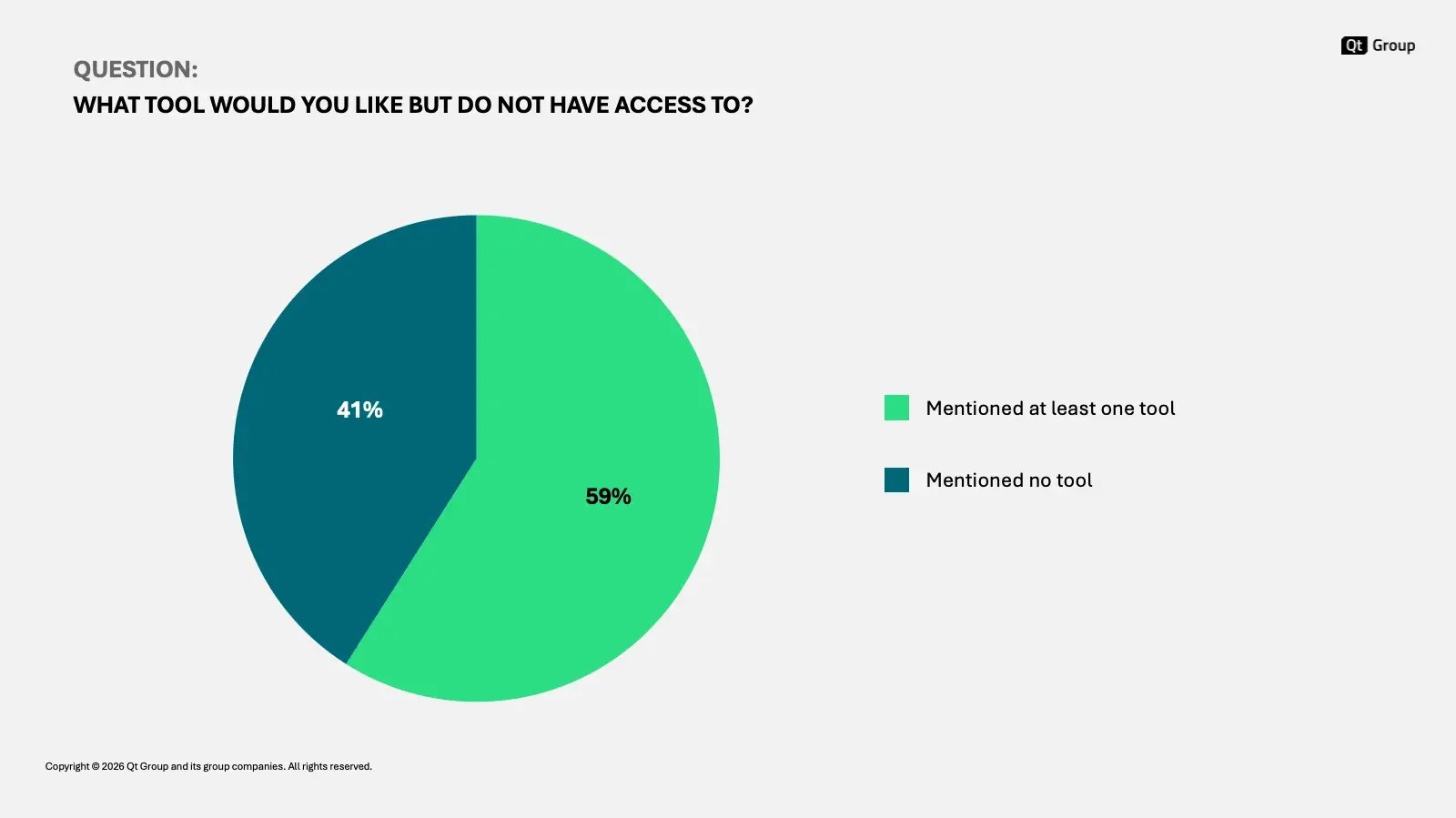
Most embedded UI/UX designers feel their current toolset isn't suited for their workflow. Yet 17% of those seeking alternatives cannot describe what that new tool would look like.
95% Report Meaningful Challenges
Almost every respondent mentioned at least one major challenge, with the top three being creative inspiration, time pressure, and brief clarity.
63% Already Use AI In Their Workflows
Embedded UI/UX designers increasingly turn to AI to address their most common challenges, but the use of AI is not yet transformative for the profession and the field.