Published On
Mar 19, 2026
Read Time
6 mins
Industry Insights Blog Series


The robotics industry is transitioning into a new phase. What was once driven by dedicated research labs and large high-tech players is now expanding rapidly into other sectors and markets, and defining new business models. Robotics investment is booming, and even small players are racing to take advantage of this revolution in sectors like manufacturing, agriculture, and logistics. There is significant momentum around Industry 4.0 and 5.0, with a strong demand for connected, automated, intelligent systems.
Obviously, before investing millions into hardware solutions, companies need to evaluate and plan strategically a business model that, despite the technical availability, is new to many. Digital simulation is used to plan and define robot operations with a smaller investment in a digital replica of the new industrial setup. In this space, the ability to prototype rapidly, to iterate efficiently towards production with a design-friendly graphics framework and ready-made UI/UX capabilities, can make all the difference in becoming a leading player of this new industrial revolution, versus being left out of the game.
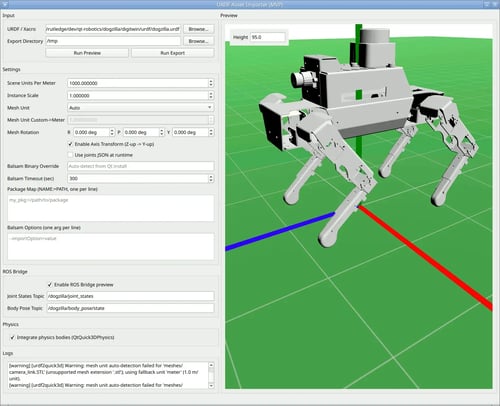
In the robotics industry, almost every robot is described using a format called URDF (Unified Robot Description Format), and nearly every robot runs on ROS (Robot Operating System). These are the two pillars of the robotics ecosystem. The project demonstrated in the video includes a Python-based exporter tool that reads a standard URDF file and automatically generates a complete Qt Quick 3D QML scene with the robot's 3D model. Additionally, connectivity with the real robot (MyCobot 280) through DDS (Data Distribution Service, the communication layer used by ROS2), enables subscribing to the robot's joint states and publishing joint commands. Such two-way communication shows that Qt can serve as a production-ready HMI for ROS-based robots, not just a viewer.
Join Our Webinar: Qt Bridges Into Robotics
Industrial Robotics - Business Outlook
The growth in the robotics sector is driven by rapid advances in AI and machine learning, which are enabling entirely new use cases and business models that did not exist before. But there are other macro trends converging at the same time:
-
Labor shortages and rising costs are pushing companies toward autonomous and semi-autonomous systems
-
Collaborative robots (cobots) are becoming more common, increasing the need for fleet management systems
-
Democratization of robotics is opening the market to smaller companies and entirely new sectors such as agriculture, logistics, and healthcare
Investors are attracted by robotics’ ability to generate revenue at scale, faster than traditional industrial approaches. At the same time, robotics is no longer primarily hardware-driven. The software ecosystem—data, intelligence, and user experience—has become a strong differentiator and a source of revenue.
Community-driven ecosystems have played a crucial role in this acceleration. Initiatives like ROS2 have significantly reduced the cost and time required to prototype robotic applications. But still, much of modern robotics development relies on fragmented ecosystems—such as Gazebo, RViz, NVIDIA Omniverse, Isaac Sim, in addition to ROS2, and open robotics description formats like URDF, SDF, and OpenUSD. These tools allow teams to model robots, simulate environments, and validate autonomy—but when transitioning toward production-ready HMIs, control stations, embedded UIs, and industry-grade UX, no unified runtime framework exists.
The transition from prototype to production is becoming more demanding. Advances in simulation tools within the ROS ecosystem—combined with platforms like NVIDIA Omniverse—have made high-fidelity simulation accessible and practical.
Value can come from training data and real-world operational insights—whether in factories or in consumer environments. This is the reason investors see such strong growth potential in the robotics economy.
Simulation is no longer a research-only activity or something confined to universities. It is increasingly used directly in production workflows, enabling companies to validate behavior, performance, and safety before deployment.
Currently, the industry is still adapting robots to legacy workflows. But as tools improve and development accelerates, companies are beginning to rethink entire processes—including factories with minimal or no human presence.
In periods of rapid technological change, fast movers gain disproportionate advantages. Teams that can prototype rapidly, push boundaries, and transition smoothly into production are the ones that will win. Organizations must be ready to capitalize quickly. The faster the development cycles become, the greater the advantage for teams that can move efficiently from experimentation to deployment.
Providing a platform that supports both rapid prototyping and an easy path to production is therefore essential.
User Experience and Developer Productivity
Today, differentiation is becoming a critical need beyond hardware and middleware. Usability, human-machine interaction, and user experience are becoming key competitive factors. Robots must feel helpful and trustworthy, not intimidating. Achieving this requires thoughtful UI design.
However, robot developers are typically not UI developers, and vice versa, UI designers are not expert programmers in robotics. The two profiles focus on different layers of the system, which makes bridging robotics middleware and UI development a significant challenge.
In this space, Qt Framework offers strong opportunities. QML has a gentle learning curve and allows UI developers to contribute effectively without deep robotics expertise. Rather than requiring complex, time-consuming integrations between the ROS2 middleware and UI frameworks, the goal is seamless, natural integration that works intuitively for both worlds.
Qt Robotics Framework
Qt Robotics Framework (QRF) introduces a modular, extensible robotics interoperability and visualization stack packaged for OEMs building robots, automation equipment, simulation platforms, and human-machine interfaces. QRF provides native import of robot assets, first-class integration with ROS2 and Omniverse pipelines, real-time data visualization, and high-performance UIs deployable across embedded, desktop, and industrial hardware.
The goal is to support and strengthen the ROS2 ecosystem by accelerating experimentation, lowering entry barriers, and helping the community build better prototypes faster. Overcoming these constraints is vital to unlocking the full potential of edge AI in industrial applications.
Qt’s approach focuses on providing add-ons that enhance developer productivity rather than proprietary solutions that fragment the ecosystem.
From day one, developers can both control the robot and visualize its data in a way that fits their specific project—not just generic tooling.
This initiative positions Qt as the runtime layer for robotics HMIs and simulation‑linked control systems, completing the workflow from simulation to deployment to operation.
Feedback from the community is essential to ensure that what is built addresses real pain points and delivers genuine value.
Technical differentiation
For many ROS developers, observing and controlling robot behavior often starts with command-line tools. While functional, this quickly becomes frustrating as systems grow more complex.
Community tools like RQT and RViz—also built with Qt—allow basic monitoring and visualization, but they are limited to predefined data types. Use of custom data structures often requires writing plugins, which adds significant overhead. Compared to existing community plugins, QRF uses strongly typed data. This ensures that interfaces are well defined. When message definitions change, data handlers can be regenerated automatically. Developers benefit from IDE auto-completion, compile-time and runtime error detection, and clear data structures. This eliminates guesswork, reduces bugs, and saves substantial development time.
Additionally, the availability of modern and efficient 3D graphics libraries like Qt Quick 3D and comprehensive, ready-made UI capabilities to create tailored interfaces helps developers rapidly move from early prototypes to production applications. For instance, with QRF bridge we were able to build custom steering and monitoring UIs using QML with minimal code and our comprehensive example applications have been built in less than two days!
Looking Ahead
Robotics is here. The ROS2 middleware is mature. The market demand is urgent. Powerful tools are available. The next growth phase will be driven by execution—by teams that can combine robotics, AI, and UI into cohesive, production-ready systems. Qt Group's focus now is on enabling that transition and working closely with the community to shape what comes next.
Related Articles
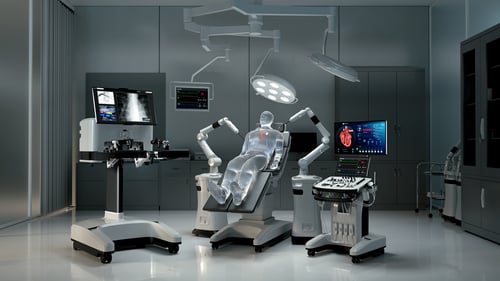

Robots are no longer confined to factory floors. They are increasingly present in environments where usability, trust, and real-time visibility are critical.