RESPONSIBLE AI-AUGMENTATION AT EVERY STAGE OF YOUR SOFTWARE LIFECYCLE
AI for Code Quality, Not Just Code Generation
AI is changing how software gets written. Qt Groups Software Quality tools make sure it still gets tested. From automated GUI testing and code coverage to static analysis and architecture verification, our AI capabilities give your team faster insights, smarter workflows, and the confidence to ship.
In any environment, with any model.
When AI generates production code and gets it wrong, the result is a bug in your product. When AI assists with quality assurance and gets it wrong, the result is a process that needs fixing. The failure mode is fundamentally safer.
In July 2024, a faulty configuration update crashed 8.5 million Windows computers. Emergency services shut down, flights were grounded, surgeries were cancelled. The contributing failures were the kind that introductory computer science courses cover.
With AI-assisted code generation, the risk compounds. Research suggests close to half of all AI-generated code contains exploitable flaws. The industry is moving faster. Software quality workflows haven't kept pace.
Three separate commitments
Our Approach to AI in Software Quality
Our strategy is built around three commitments:

AI that works inside your tools
The best AI assistance is contextual. It understands your codebase, your test scripts, your coverage data, and your architecture.
We carefully considered where to integrate AI into our products to give it the best possible context it needs. AI has to be useful, not just plausible.
AI that works with the tools you already use
Engineers have standardized on AI code assistants they trust.
Rather than asking them to abandon those workflows, we're making our tools first-class citizens inside them through MCP servers, CLIs, and open APIs that connect our QA tools to any AI assistant.
AI that works in any environment
For teams in regulated industries, data sovereignty isn't optional. Our AI capabilities are built to support model-agnostic, on-premise deployments.
So you choose the model, and you control where your data goes.
AI is reshaping how development teams work, but the right level of integration looks different for every organisation. All of our Software Quality Solutions products are built to connect seamlessly into the AI environments your teams already rely on. For those companies ready to take AI integration a step further, we also offer solutions which include the AI capability in the product itself. Our goal is to meet your team where you are, not where we think you should be.
Bastian Steinbach, Director Product Management, Software Quality Solutions at Qt Group
Close the Loop Between AI Coding and AI Quality.
The AI-Native Development Pipeline
When your team uses AI code assistants to write features, our MCP servers keep quality in check:
-
Axivion catches violations and architecture deviations before code is committed.
-
Coco identifies untested paths and iterates on unit tests until coverage targets are met.
-
Squish generates and validates GUI-level test scripts against the finished feature.
The result is an AI-augmented quality loop throughout the development lifecycle.
→ Explore Squish MCP | → Explore Coco MCP | → Explore Axivion MCP
Spend Less Time Proving Quality.
Accelerating Safety Certification With AI Assistance
Safety certification is evidence-driven and time-consuming. Our AI capabilities help gather that evidence faster without cutting corners.
-
Axivion MCP surfaces e.g. MISRA, CWE, and CERT violations at the moment they are introduced.
-
Coco MCP drives unit test generation toward MC/DC coverage targets recognized by TÜV-certified tooling.
-
Squish MCP and the Squish AI Assistant handle the automated functional test layer.
Together, they reduce the time between code complete and certification-ready across ISO 26262, IEC 61508, IEC 62304, and DO-330 projects.
→ Explore the full Qt QA portfolio for safety-critical development
More Complexity. No Compromise on Quality.
Scaling Software Quality Without Scaling the Team
As software scope grows, QA headcount rarely keeps pace. Our AI capabilities target the manual overhead that consumes the most time:
-
Squish MCP removes the effort of authoring test scripts from scratch.
-
Squish Vision eliminates maintenance when UIs change.
-
The Squish AI Assistant cuts failure triage time.
-
Coco MCP closes coverage gaps without manual iteration.
-
Axivion MCP catches violations before they reach review.
Each saves time individually. Together, they significantly expand what a fixed-size team can cover.
AI Capabilities Across the Qt Software Quality Portfolio
Five Solutions tailored towards your needs for building and testing future-proof systems
- AI-Connected Static Analysis
- Automated Test Generation
- AI-Assisted Test Creation
- Code Coverage with AI
- AI-Powered Visual Testing
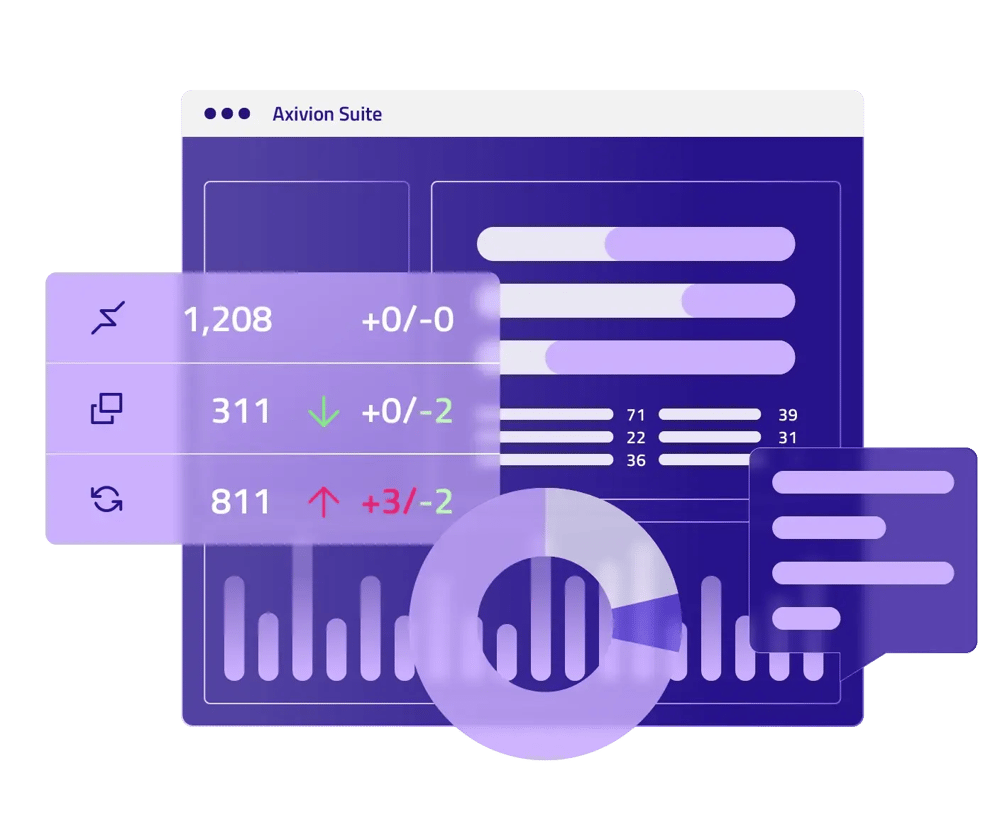
Axivion MCP Server
The Axivion MCP server brings static code analysis and architecture verification directly into your AI coding workflow. Let AI generate code and Axivion check it against rules, architecture, and compliance requirements before it is shipped. Violations are explained, fixes suggested, knowledge gaps closed. All inside your IDE.
AI coding carries the same compliance obligations as human-written code, and therefore Axivion holds it to the same standard. Your AI assists, Axivion verifies and every release stays audit-ready thanks to the high level of AI code quality.
The analysis engine stays deterministic and AI-free, fully qualifiable under your applicable safety and coding standards. You decide which level of AI integration fits your project and risk profile.
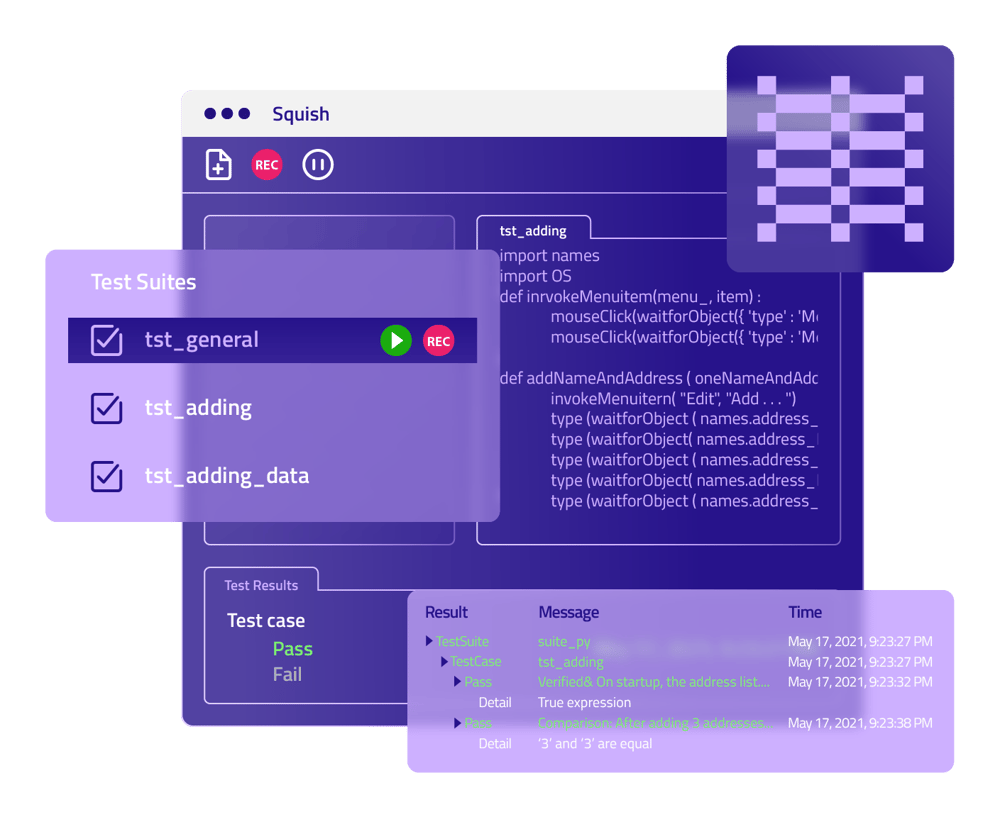
Squish MCP Server
The Squish MCP server connects the AI code assistants your team already uses — Cursor, GitHub Copilot, Windsurf, Claude Code — directly to Squish's testing infrastructure. With the right context in place (Squish rules, indexed documentation, a product spec, and your object maps), AI can generate reliable test scripts, execute tests, and analyze failures from within the AI assistant itself.
Context separates useful output from noise. Our practical guide walks through exactly how to set it up.
Squish AI Assistant
An AI assistant built directly into the Squish IDE. No switching tools, no copy-pasting logs into a chat window — the assistant understands your test scripts, object map, test results, and the Squish framework itself.
In practice, it helps with three things:
Failure Analysis. Understanding why a test failed often takes longer than fixing it. Instead of tracing logs line by line, ask the assistant to summarize the failure and suggest where to look first. For teams running large suites overnight, this turns morning triage from an investigation into a conversation.
Refactoring. Test scripts accumulate technical debt just like production code. The assistant reviews scripts and suggests improvements for maintainability and efficiency, recommending Squish-specific patterns your team might not find on their own.
Knowledge Transfer. When a senior QA engineer leaves or someone new joins, understanding an existing test suite can take weeks. The assistant fills the gaps where documentation has fallen behind — anyone can ask what tests do, why they're structured that way, and what behavior they validate.
Supported LLMs: OpenAI, Mistral, PrivateGPT, and more.
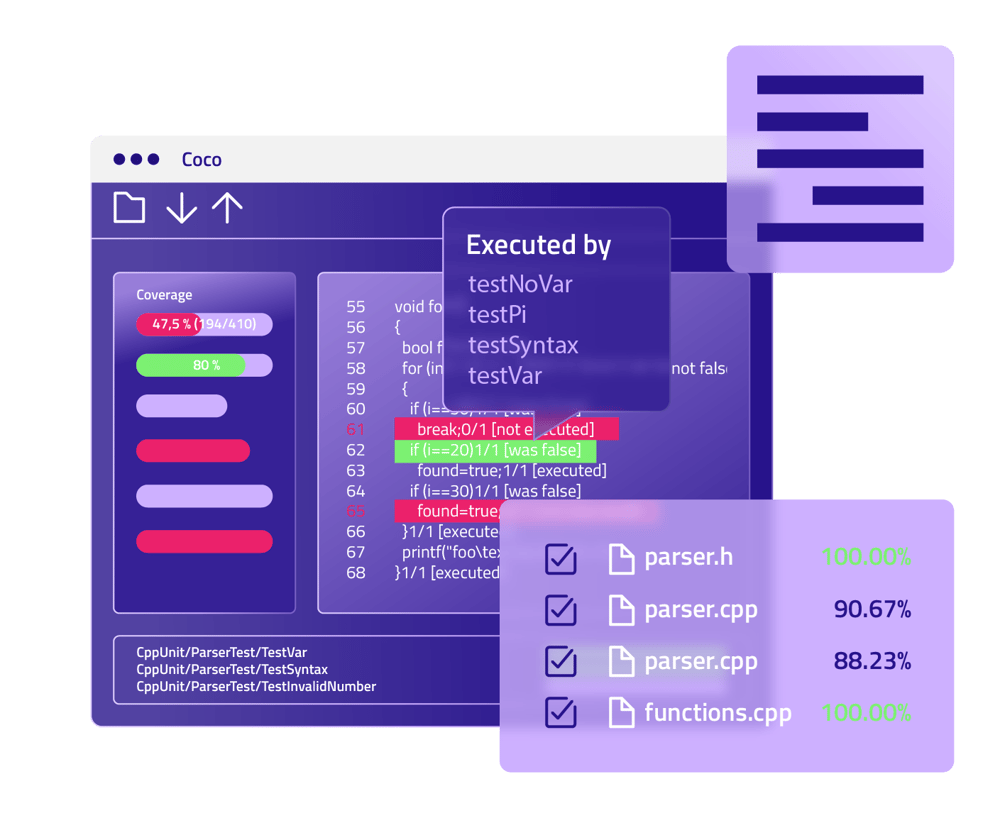
Coco MCP Server
With the Coco MCP server, an AI coding assistant like GitHub Copilot, Cursor, or Claude Code can read your coverage reports directly, identify which parts of the codebase have never been tested, generate unit tests that target those specific gaps, and verify that coverage actually improved, not as a number on a dashboard, but in the specific paths that carry real risk.
For teams using AI to write code faster, this closes a gap that speed alone creates: AI generates code, Coco measures what the tests actually cover, and the assistant can act on what's missing before it becomes a problem in production.
IEC 50716
Squish Vision
Traditional GUI test automation relies on selectors, object properties, or internal app code to find UI elements. When a layout changes, a theme updates, or a resolution shifts, tests break. This maintenance overhead can consume more effort than writing new tests in the first place.
Squish Vision approaches this differently. Using computer vision and purpose-built locally running models, it detects and interacts with UI elements the way a human would visually, based on what makes each element recognizable rather than what it looks like at one exact moment. Framework-independent, resilient to UI changes, and running entirely on your machine with no cloud dependency.
Where to Start?
If your challenge is…
Understanding why tests fail
Writing new test scripts fast enough
Tests breaking when the UI changes
Knowing which code your tests actually cover
Managing static analysis findings at scale
Start here
Squish AI Assistant
Squish MCP + AI code editors
Squish Vision
Coco MCP
Axivion MCP
This Might Interest You
Software Quality Solutions
Get an overview of our entire product portfolio for AI quality and AI code assurance
Resource Center
Explore our webinars, whitepapers, e-books, success stories and more and learn how we can support responsible AI augmentation.
Ready to try Yourself?
Start your free trial today and explore your possibilities with AI-powered software testing.