Published On
Apr 7, 2026
Read Time
6 mins
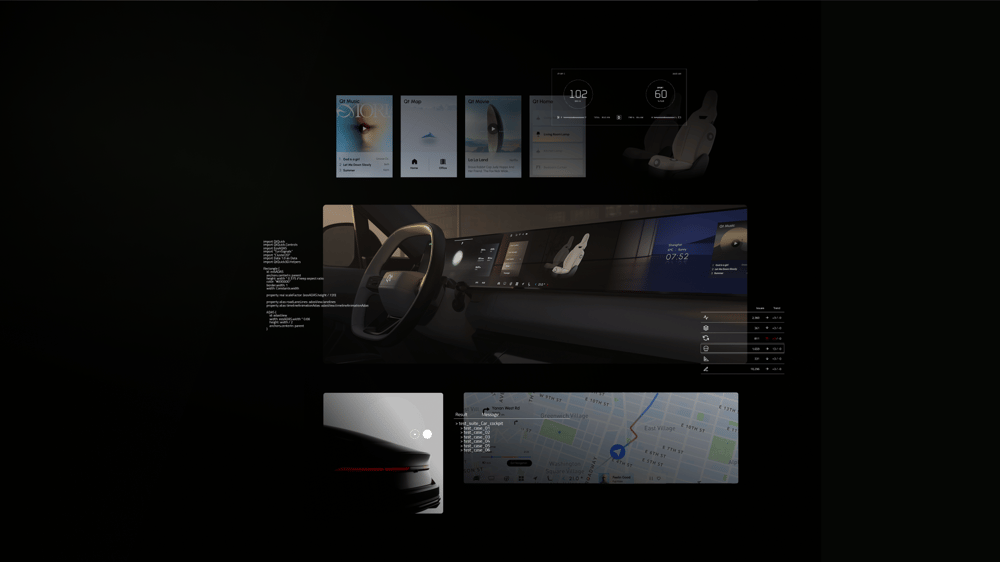
Qt Group is coming to Auto China 2026. Here's what's on our mind, and on the show floor.
The Software-Defined Vehicle Isn't a Future State
The Software-Defined Vehicle isn't a future state. The pioneers already built it.
Walk around any Chinese auto show in the last few years, and you understand immediately what the new competitive standard looks like. Panoramic displays that react to the driver. Transitions between modes that feel deliberate and cinematic. Autonomous capabilities that genuinely change how people use their cars. Chinese OEMs raised the bar for what in-vehicle software should feel and behave like, and raised it fast. The global industry is still catching up.
That pace creates real demands. A vehicle that wowed at launch needs to stay just as alive two years later. The experience needs to scale across models, price points, and regions without rebuilding it each time. And as Chinese brands expand globally, the same software stack that won at home needs to meet the safety and compliance requirements of Europe and beyond.
The brands managing all of this treat the vehicle as a living platform. They ship new capabilities over the air, iterate based on real-world usage, and innovate from a single, flexible software foundation. Speed and control are a single capability when the foundation is right. The question now forming in the industry is the harder one: how do you keep that pace sustainable as the software itself grows more complex with every cycle?
That's what we're coming to Auto China 2026 to talk about.
Outpace the 3D Trade-Off
At the center of our presence is Outpace, our new-generation automotive HMI concept demo. Built with the most ambitious in-vehicle programs in mind, it answers a question many teams are dealing with right now: Does delivering a world-class in-vehicle experience require compromises on engineering or cost?
The answer is no. Outpace makes the case for that.
Many teams moved toward game engines to get the 3D visual quality their designs demanded. Game engines are powerful rendering tools — but they were built for gaming. The embedded, safety-critical environment of a production vehicle has very different requirements. On a shared compute platform where the IVI, instrument cluster, ADAS, and other systems all coexist, game engine runtimes compete for the same resources. What worked in the prototype starts to constrain the production program. Safety architecture becomes harder to close. The experience that won the design review quietly becomes an engineering and timeline problem.
Outpace shows what Qt's approach makes possible. It runs real-time 3D rendering with seamless 2D-3D integration on mid-range automotive silicon. The software architecture is designed from the start to meet production safety and compliance requirements, avoiding unnecessary retrofits later. And the visual quality is the kind you need to see in person.
Two capabilities deserve particular attention.
Rendering as a Service (RaaS) lets the same 3D assets serve every screen in the dashboard (cluster, infotainment, passenger displays) simultaneously from a single renderer. Cinematic transitions, consistent 3D across the full display estate, with far less hardware overhead.
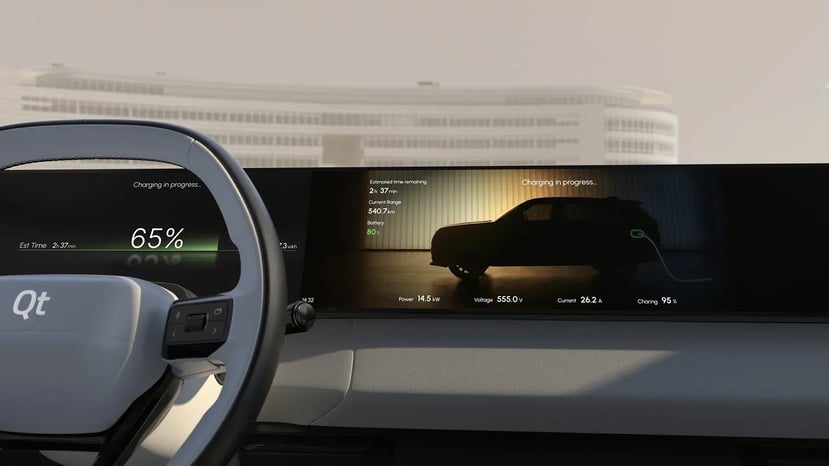
Surrounding Reality is a ready-to-use template that projects real-time 3D visualization of what the vehicle's sensors see around the car directly into the vehicles dashboard. Replace the 3D models, adjust the color scheme, connect your data source. What used to take months to build can now be done in weeks.
The demo's central argument: design ambition and production reality can live in the same program, on time and at cost.
Owning the Platform, Not Just the Experience
A great demo shows what's possible. Keeping the underlying software under control as it scales is a different challenge.
When complexity grows without discipline, the gaps start small and widen fast. The system as designed and the system as built start to diverge. Suppliers deliver components as compiled binaries (which is entirely reasonable), but the OEM still owns the quality and safety of the integrated whole, including the parts it can't directly inspect. Technical debt accumulates not from carelessness, but from the natural pressure of shipping across many programs under deadlines.
An actively maintained codebase scales across models, suppliers, and new features. While a fragmented one, patched under pressure, doesn't. The most common scenario is still navigating between both, which brings unique challenges of its own.
For teams entering global markets, this becomes concrete very fast. Building quality and ensuring Functional Safety into systems automatically throughout development makes compliance easier to manage. Still, the current, most common operating model of leaving it to the end makes it one of the biggest bottlenecks in automotive software development programs.
Qt Group's tools span the full development lifecycle, from HMI creation to software quality, architecture verification, and compliance. They work best as a connected whole, and together they give engineering teams the control to build automotive software that holds up across programs, models, and markets.
Explore Automotive Development Tools
Learn About Automotive Software Testing and Compliance
The Bigger Picture at Auto China
Auto China 2026's theme is "Future of Intelligence." We think that's right. But the intelligence that matters isn't only in the vehicle. We also believe it's in how it's built.
More than 40 automotive brands worldwide build with Qt Group. We've been part of this industry's most complex programs for decades, and we know what the pressure of a demanding timeline actually feels like and what it takes to come out of it with software that works, adapts, and lasts.
If you're at Auto China 2026 and any of this is relevant to where your programs are headed, we'd like to have that conversation. Bring your real questions. We'll bring honest answers.
Visit our event page and explore more
Qt Group will be at Auto China 2026, Beijing, April 24–27.
All rights reserved.
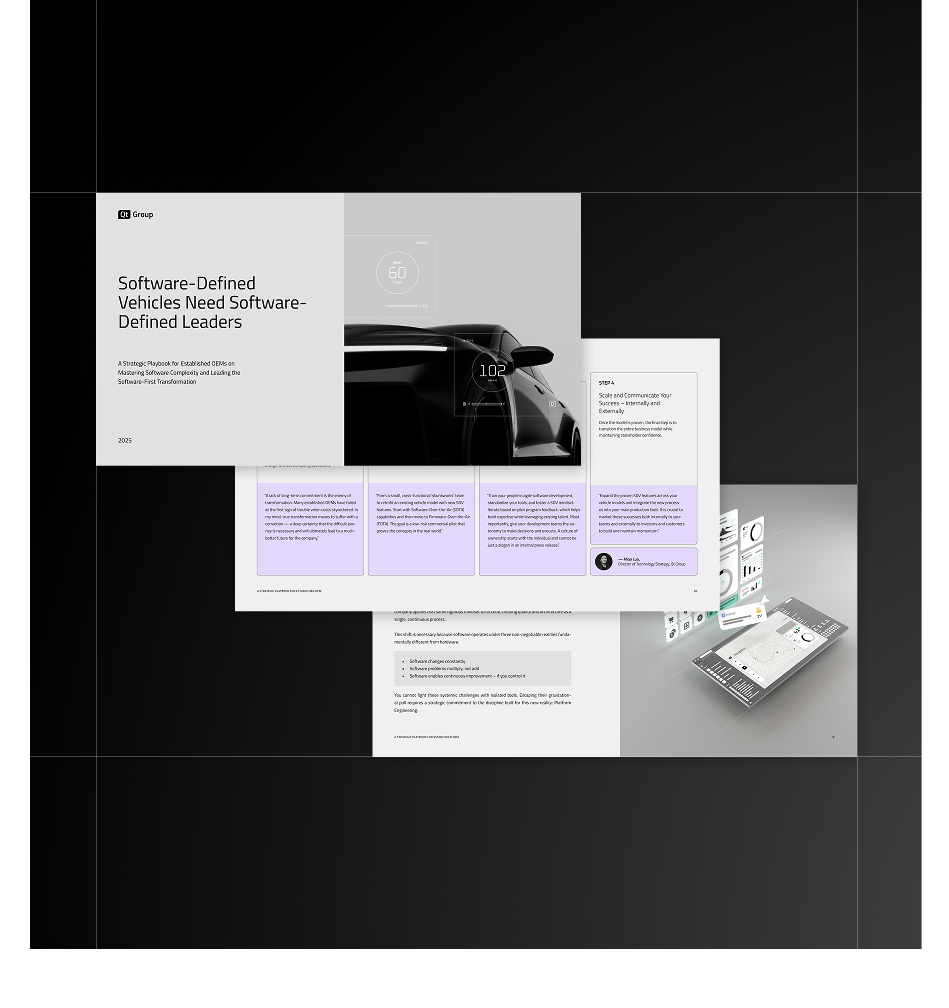
Ebook: Software-Defined Vehicles Need Software-Defined Leaders
You are delivering the software-defined vehicles the market demands. But the constant struggle with complex integrations, painful compliance, and costly software recalls proves hardware-first processes are still broken and slowing you down.
This playbook isn't for companies that are failing. It's for technical leaders who know the current cost of success is unsustainable. Learn how to shift to a software-first mindset and discipline, and take ownership of your architecture to eliminate complexity at its source.

No sign-up required