A LEADER'S GUIDE TO DETERMINISTIC FOUNDATIONS
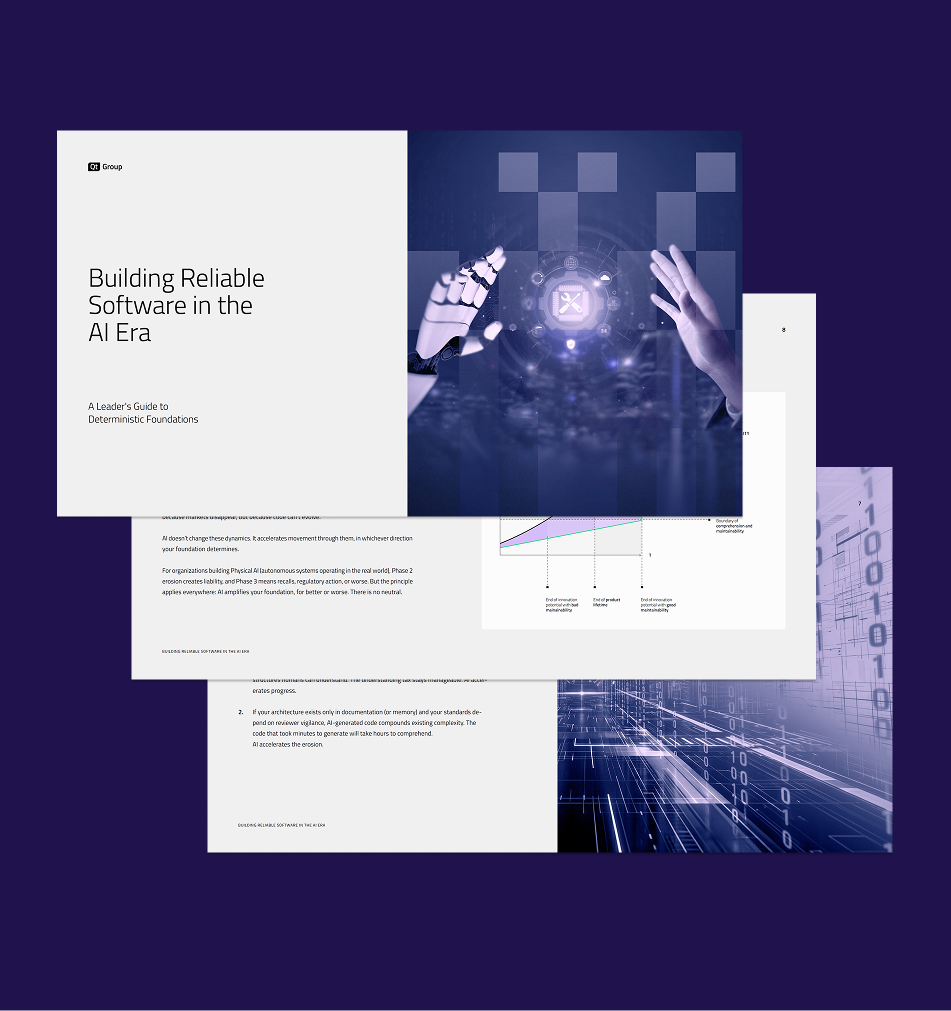
Building Reliable Software in the AI Era
AI-generated code is being committed faster than your team can review it. This guide shows why that gap compounds — and what it takes to close it before your foundation decides the outcome for you.
For leaders in safety-critical industries deciding how fast AI can safely move through their codebase.
Get the Free Guideof development time is spent just understanding existing code before a single change is made. The guide calls this the "understanding tax" — and shows what AI does to it in both directions.
WHO THIS GUIDE IS FOR
Written for Leaders Who Refuse the False Choice
Not "slow down AI to stay safe" or "move fast and hope." A third path, for people accountable for both velocity and certification.
Engineering Leaders
Managing development in automotive, medical device, industrial, or aerospace organizations where AI is arriving on the product roadmap and inside the IDE at the same time.
Architects & Senior Engineers
Accountable for architectural integrity as AI-generated code volume grows faster than any team can review it manually.
Decision-makers
Evaluating whether current verification processes can support AI-era development — or whether the foundation needs to change first.
YOUR TAKEAWAYS
By the End of the Guide You Will Understand
Why AI amplifies your foundation
For better or worse — and why there's no neutral setting.
What separates thriving teams from drowning ones
The specific capabilities behind AI-era development done right.
How to spot a foundation that won't scale
Four concrete warning signs you can check for this week.
What it takes to build verification that scales
The four capabilities of a trusted software infrastructure — and where to start.
START READING
The Opening Pages, Straight From the Guide
Here's the preface and the first chapter, unedited. The rest — the false choice, the three pillars of trusted infrastructure, and the six-phase path forward — is in the full PDF.
PREFACE
The Question You're Already Asking
You're managing a development organization in a safety-critical industry. Your products must meet standards like ISO 26262, IEC 62304, or IEC 61508. Your team has processes, certifications, expertise built over years.
And now AI has arrived on two fronts simultaneously.
Your product roadmap includes AI-driven features, perception systems, adaptive algorithms, and intelligent automation. The market demands them. Your competitors are shipping them. Standing still isn't an option.
Meanwhile, your engineers are using AI assistants daily: code generation, test suggestions, documentation. Productivity is up. Telling people to stop using them isn't realistic.
Here's the question that deserves a real answer:
Can your current verification processes handle both?
01 - WHAT AI ACTUALLY DOES TO YOUR CODEBASE
The Understanding Tax
Research shows roughly 50% of development time is spent understanding existing code before making changes. This means simply figuring out what already exists. We call this "the understanding tax." Every engineer pays it daily.
AI-assisted development changes this equation in one of two ways: if your architecture is verified and your standards enforced, AI-generated code fits into structures humans can understand — the understanding tax stays manageable, and AI accelerates progress. If your architecture exists only in documentation or memory, AI-generated code compounds existing complexity. The code that took minutes to generate will take hours to comprehend.
AI accelerates the erosion.
To continue reading fill out the form below.

Axivion Suite — where AI Generated Code Meets Verified Architecture.
Axivion Suite is the only holistic solution for both, structural and system integrity. No matter who or what wrote your code.