
AGENTIC DEVELOPMENT WITH Qt
Production-Grade Productivity with AI Across Platforms
Agentic development is multiplying productivity across the full software creation lifecycle from code generation to testing to documentation. Qt gives your teams the infrastructure to do it safely, also on constrained, embedded hardware.
Your Embedded Teams Are Already Experimenting
The Question Is Who Gets AI to Production First
Most development teams are experimenting with agentic development, now more and more also for embedded software. But far fewer teams can confidently get the AI-generated code into production on hardware where a bug doesn't just crash an app, it crashes the device.
Productivity
Agentic development doesn't just assist. It multiplies. It allows developers to delegate entire tasks to AI agents. Teams using agentic workflows for coding, testing, and documentation are outpacing individual developer productivity by a significant margin.
Embedded Mastery
Embedded constraints don't disappear because tooling is exciting. Limited memory, real-time requirements, safety certifications, and regulatory obligations all remain. The trick is to work within those constraints, not around them.
Structural Shift
The shift to the AI era is structural, not cyclical. Teams building the muscle now, with agentic workflows, human-in-the-loop oversight, and hardware-aware optimization, will gain compounding advantages.
Faster Time to Market
Agentic workflows compress the full development lifecycle from UI design to test generation to documentation, so your team ships faster without cutting quality corners.
AI Cost Optimization
Qt's open source foundation means LLMs already know Qt, and dedicated agent skills and MCP tools lower the token consumption, keeping your agent infrastructure economical at scale.
Reduced Compliance Risk
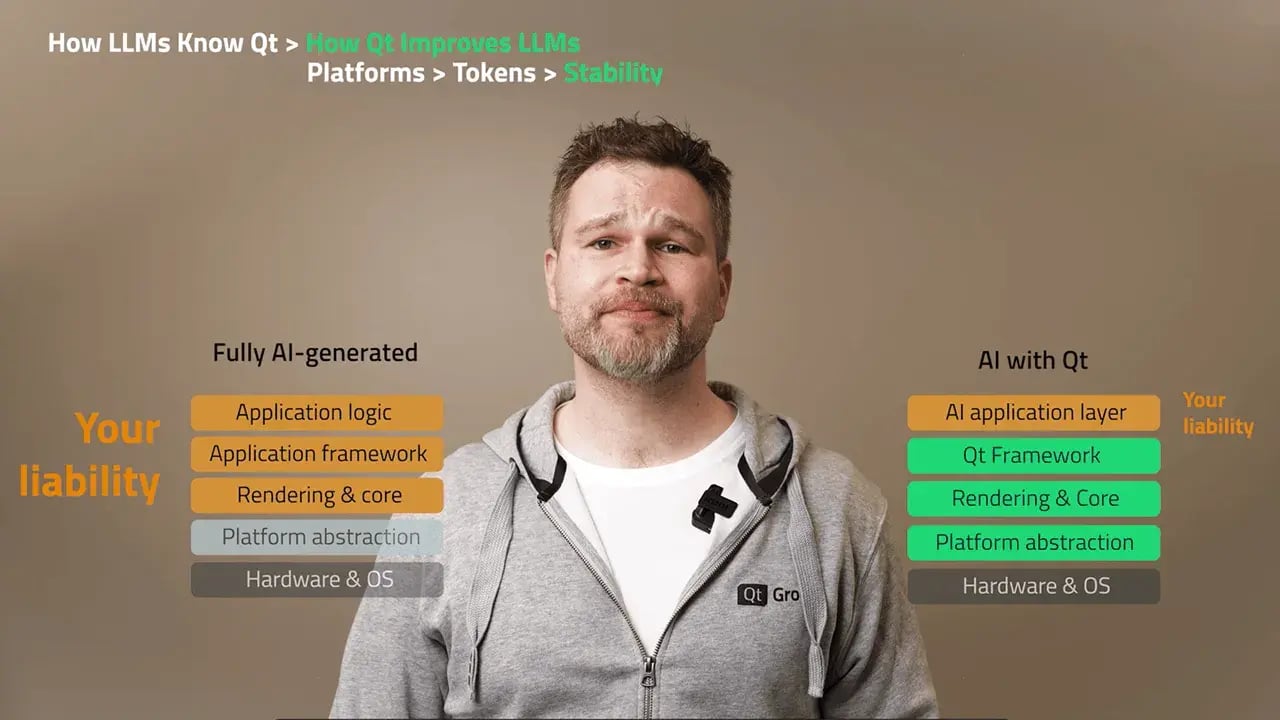
Qt is a solid foundation to build on. AI-generated code only adds a thin, manageable AI layer on top, improving your cybersecurity, stability, and readiness for regulatory compliance.
Talent & Team Scalability
When AI agents handle repeatable work, your developers can focus on where human judgment is genuinely required, such as directing the workflows and evaluating outputs effectively.
PRODUCTIVITY ALSO FOR CONSTRAINED ENVIRONMENTS
What Is Agentic Development?
Agentic development is a software engineering approach in which AI agents receive goals to autonomously plan, execute, and iterate across multi-step tasks, such as writing code, running tests, generating documentation, or reviewing codebases. The role of a human engineer is to direct the workflow and approve outputs.
This differs from AI-assisted coding in scope. AI assistance responds to a developer's prompt and stops there, so that the developer still decides what to do next. Instead, an agentic workflow delegates the work itself: the agent breaks the goal into end-to-end sub-tasks, calls the tools it needs, checks its own output, and delivers the result for human review and approval.
What makes this significant is the combination of scale and control. Agents can run in parallel, work across large codebases, and complete in minutes what would take a developer hours. At the same time, the human-in-the-loop architecture ensures that speed doesn't come at the cost of quality or safety. For embedded software teams, it matters even more, as the human control makes agentic AI viable also for regulated, constrained, and safety-critical environments.
CROSS-PLATFORM AGENTIC WORKFLOWS
The Shift is Already Happening
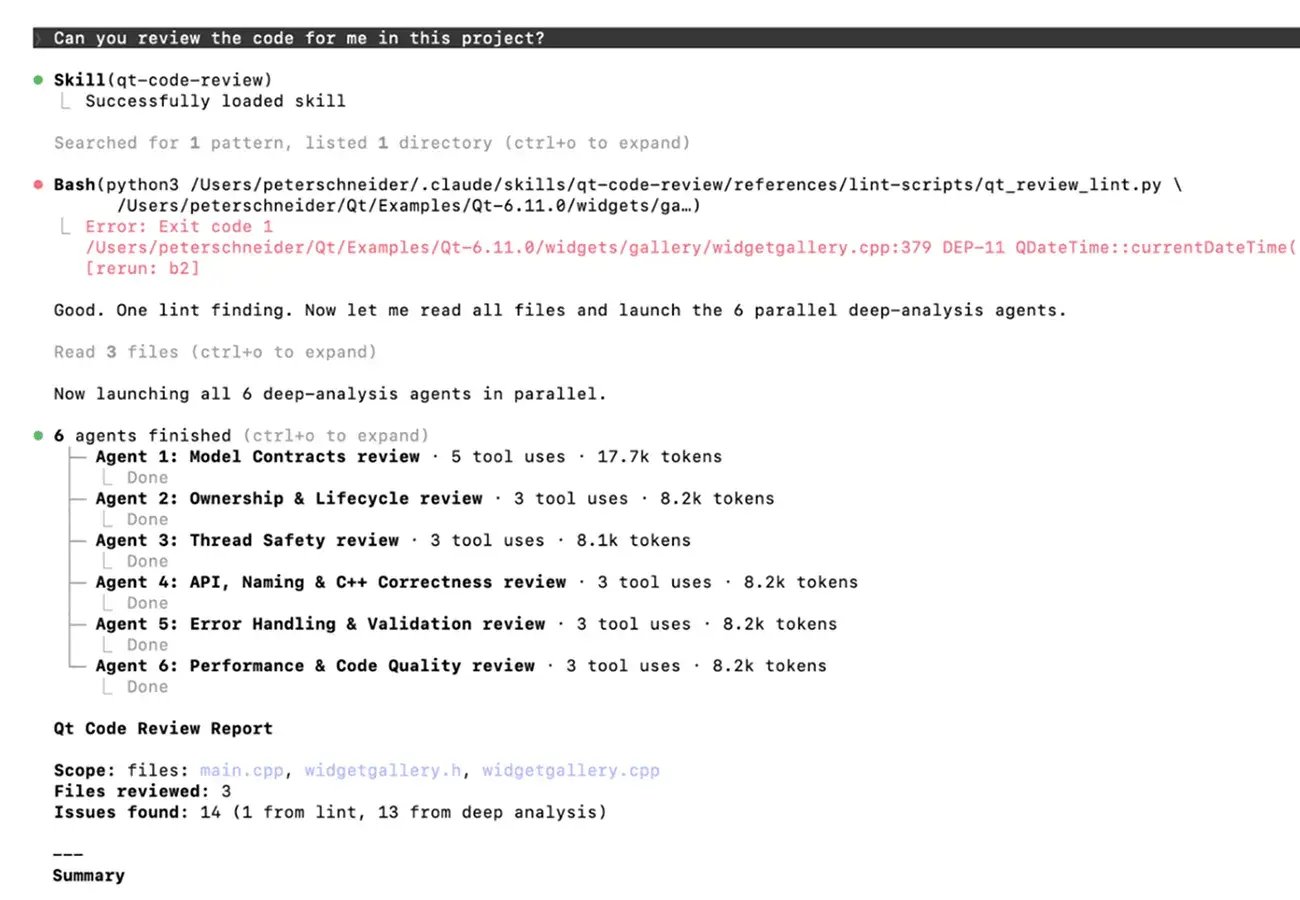
Agentic workflows are transforming programming with productivity levels that no individual developer can match alone. Workflows for writing code, generating tests, and navigating projects are more and more executed by AI agents, however, we at Qt believe the human-in-the-loop remains, and should remain, the director of those workflows.
How Agentic AI Impacts Productivity: Examples
75-86%
Score by leading models on the QML100 benchmark for single-turn agentic tasks.
10×
Multiplied productivity from e.g. agentic documentation compared to mere AI-assistance.
30%
Of MCP token consumption cost compared to generic agentic web search.
WHY Qt FOR AGENTIC SOFTWARE DEVELOPMENT
What Sets Qt Apart
Qt is not a generic AI layer on top of a generic framework. It's the only platform where the framework, the tooling, and the agentic infrastructure are built together, providing excellent cross-platform support, also for embedded software.
Purpose-built for cross-platform development
Qt's dedicated agent skills and MCP services are designed for cross-platform development, especially considering constraints of various target hardware. They're not adapted from general-purpose tools. No other platform offers this combination on the level that Qt does.
LLMs already know Qt better than most alternatives
Qt's open source allowed frontier models like Claude, GPT, and Gemini be trained on a vast body of real Qt code, documentation, and other online content. Closed-source frameworks can't offer this, meaning your agents already start smarter with Qt.
Human-in-the-loop when reasonable
Qt's agentic architecture keeps your developers as workflow directors, not passengers. Agents' work is validated by a human developer at every stage of the development process, if you decide so. You remain in control of what your agents can and can't do.
Hardware-in-the-loop when beneficial
When your software needs to run reliably, especially on resource-constrained embedded devices, performance and stability are critical.
With decades of expertise on embedded software, building with Qt helps AI agents to generate lean code that follows hardware best practices. Agents can, for example, optimize and re-deploy your code based on live performance data without a human in the middle, orchestrating entire agentic workflows from framework to toolchain to target.
Open toolchain with standard AI compatibility
Qt readily works with Claude Code, GitHub Copilot, Codex, and other leading agentic engineering tools. The framework is verified to follow open standards so you're not locked into a single AI vendor.
Stability for regulated industries
Medical, automotive, aerospace, and industrial applications have unique compliance requirements. In the EU, the Cyber Resilience Act (CRA) is setting tight requirements for software products in most industries. Qt Framework provides a solid foundation for regulatory compliance, including the CRA, functional safety standards, ISO 26262 and IEC 62443 environments, and more.
When you use Qt as a foundation and only add a think AI layer on top of it, managing your stack and meeting regulatory requirements is significantly easier.
SEE HOW IT WORKS
Agentic Development Across the Full Software Lifecycle
Watch how Qt's agentic workflows handle the tasks that consume your team's time, so that developers can focus on the directing and making decisions that require human input.
What you'll learn:
00:00 Agentic coding for real production software
00:23 Why LLMs already know Qt
01:14 Benefit 1: Cross-platform and embedded performance
02:24 Benefit 2: Token consumption and cost
03:00 Benefit 3: Stability, security, and compliance
03:46 Closing
FOR ENGINEERING LEADERS
What Agentic AI Actually Changes
Beyond productivity numbers: what the agentic shift means for how you hire, govern, and lead your development teams.
GAIN
Balanced Development Capacity
Agentic tools absorb the volume work not just for coding, but also test generation, documentation, and code review, even for large codebases. Your senior developer effort is redirected toward architecture, system integration, and the safety-critical decisions that genuinely require human judgment.
GAIN
Faster Iteration with Managed Risks
Qt delivers the stable base layer. Agentic customization happens on top, within a controlled scope. You get the speed of AI-accelerated development without exposing your software to unconstrained code generation.
GAIN
New Hiring & Onboarding Economics
Agentic workflows lower the floor for new team members to become productive quickly. Domain knowledge stays encoded in agent skills, not locked inside individual's minds. Your institutional knowledge becomes systematically shareable.
MANAGE
Trust, Autonomy & Verification
The teams that succeed draw an explicit line on what agents can do autonomously and what requires human sign-off. Qt's human-in-the-loop architecture gives you the structure to define and enforce that line, instead of just assuming it will self-regulate.
ON-DEMAND PANEL DISCUSSION
Hear from Embedded Practitioners Who Are Already Doing It
Listen to four embedded development experts in a candid conversation about what agentic software development actually looks like in production, not just in theory.
EXPERT PANEL: VISIONARY VOICES OF TECH
Agentic Development for Embedded Devices: From Experiment to Production
Listen to an online panel discussion with four expert practitioners sharing what getting agentic code reliably into production actually looks like: how they are using agentic workflows across the full embedded development lifecycle, where they draw the line on trust and autonomy, and what this shift means for the people leading these teams.
Discover how embedded teams go agentic beyond just code generation
Learn what reliable AI-generated code looks like
Implement hardware-in-the-loop thinking into your workflows
Understand what this means for your team, roles, and hiring decisions
YOUR PANELISTS
Jacob Beningo
CEO
Beningo Embedded Group
Przemyslaw Nogaj
Head of HMI Technology
SpyroSoft
Peter Schneider
Principal of Product Management
Qt Group
Hosted by Kimmo Leppälä, Senior Director at Qt Group
Qt's Agentic Tools
Qt provides various agentic tools to help your development teams harness the productivity gains of AI-powered production with Qt. Qt's agentic tooling works with all common AI tools, such as Claude Code and GitHub Copilot, providing them Qt- and QML-specific knowledge and context for higher-quality outcomes with fewer iteration rounds.
Agent Skills and MCP Tools
Agent skills give AI agents specialized Qt expertise for a given topic where generic LLMs fall short. MCPs give AI agents deep knowledge of Qt, improving code quality and reducing token costs.
Agents in the Qt Creator IDE
Qt Creator allows you to easily use any common AI agent within the IDE, having them perform various actions on your behalf. Qt context gets an extra boost from the ability to use also Qt Creator's own state.
Agentic AI for Code Quality
From automated GUI testing and code coverage to static analysis and architecture verification, Qt provides agentic software quality capabilities beyond code generation, covering end-to-end workflows.
Frequently Asked Questions
What is the difference between AI-assisted software development and agentic development?
- AI Tooling
- Agentic Engineering
AI-assisted tools like GitHub Copilot suggest code while the developer executes every action. Agentic development goes further: AI agents autonomously observe, plan, execute, validate, and iterate across a codebase. Productivity gains are massive: while AI assistants deliver up to 10% gains at maximum, agentic solutions multiply engineering productivity.
How does agentic development with Qt multiply productivity?
- AI Tooling
- Agentic Engineering
Qt's agent skills and MCP services handle the tasks that consume developer time but don't require their judgment, such as writing boilerplate code, test cases, API documentation, code review, and Qt-specific linting. This frees developers to focus on architecture, innovation, and the decisions that actually require human expertise.
How is agentic development transforming software creation?
- Agentic Engineering
Agentic development is bringing a structural and fast transformation to how software is created. Coding assistants broke through in 2024, fully agentic solutions gained momentum in 2025, and in 2026 the centre of gravity has moved decisively toward agentic engineering. While the human in the loop is still important, the developer role is evolving from hands-on coding to directing agentic development workflows.
Does Qt support agentic software development?
- AI Tooling
- Agentic Engineering
Yes, Qt supports agentic software development both without and within IDEs. To start with, Qt's open ecosystem means frontier models such as Claude, GPT, and Gemini have trained on Qt’s C++ and QML code, with leading models already scoring 75–86% on the QML100 benchmark for single-turn tasks. Where generic LLMs fall short, Qt fills in the gaps by providing dedicated, MCP-enabled tools and agent skills designed for agentic cross-platform development with Qt. In addition, agentic AI is supported within IDEs, for example, with the Qt Creator IDE's Qt-aware agentic AI capabilities.
What is Qt's take on agentic engineering?
- Agentic Engineering
Qt believes the human in the loop remains essential, especially in regulated industries. Qt Group’s goal is to enable developers to act as architects and directors of agentic workflows, delegating routine tasks to agents while retaining human oversight at the critical checkpoints such as design, documentation, and code review as well as quality assurance.
How does Qt compare to other UI frameworks for agentic AI?
- AI Tooling
- Agentic Engineering
Qt's key advantage in terms of agentic AI is its training data depth. Decades of open Qt C++ and QML code means frontier models write better Qt out-of-the-box than they do for closed or less mature frameworks. Qt also covers a broader hardware range than alternatives, which typically target a single or limited types of target platforms or have not yet published dedicated agentic tooling or MCP integrations.
More on Qt Framework
Qt Framework’s comprehensive set of libraries take away your routines from middleware to UI, 2D to 3D, platform to platform.
More on Development Tools
Qt allows developers to choose the tooling that they’re most comfortable with, be it agentic AI tools or an integrated development environment (IDE).
Get Started with Agentic Development
Provide your development teams with the dedicated Qt agent skills and MCP tools.