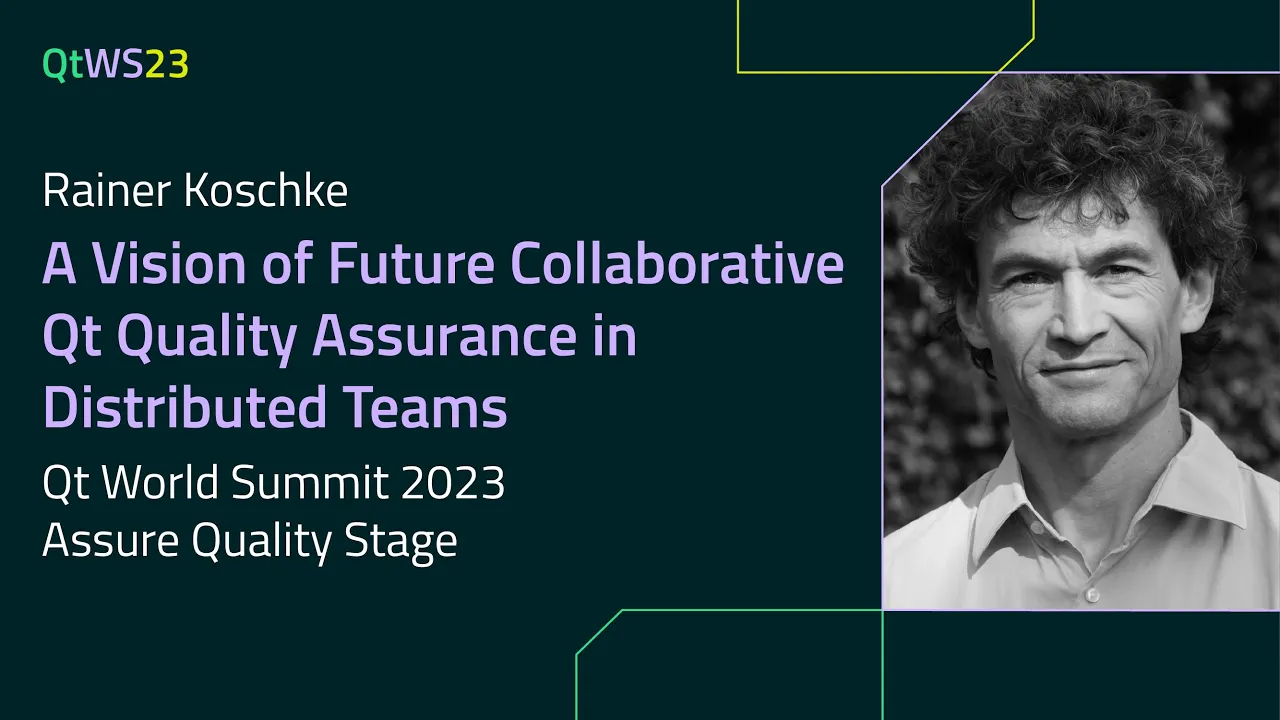
A Vision of Future Collaborative Qt Quality Assurance in Distributed Teams with Rainer Koschke
Abstract: This presentation provides a near-future vision of how quality assurance can look like when multiple stakeholders together need to look at software quality data even if they are not in the same room. The vision is driven by several ongoing trends in software engineering. First, the software is increasingly developed in distributed teams. Second, a more holistic approach to quality assurance is taken in which data from many sources are combined, such as the findings of static code analyzers (e.g., gathered by the Axivion Suite), coverage and failure data of dynamic tests (e.g., collected by Froglogic's tool set), or change data (e.g., retrieved from a version control system) to name a few. Third, the need to fuse and abstract quality data from the lower level of source code to an architectural level enabling all stakeholders to see the bigger picture. This vision materializes in our ongoing research project in which we create virtual rooms where members of distributed teams can meet to take a common look at their software and its quality. Based on the popular code-city metaphor, the architecture, and implementation can be visualized at a level of abstraction suitable for stakeholders from different domains (e.g., developers, testers, or managers). The virtual room can be entered remotely using classic desktop computers as well as modern AR/VR hardware. The members can interact with the visualization and take on their own individual perspectives. They can also see all other members represented by avatars, which allows them to trace the interactions of all others with the visualization and to see their gestures and mimics enabling non-verbal communication.
About the Speaker: Rainer Koschke is a full-time professor of software engineering at the University of Bremen in Germany and heads the software engineering group. His research interests are primarily in the fields of software engineering, program analyses, and software visualization. His current research includes program analyses, clone detection, visualization in VR and AR, reverse engineering, architecture recovery, feature location, and security. He is one of the founders of Axivion GmbH (founded in 2006) providing solutions for stopping software erosion. He received a doctoral degree in computer science at the University of Stuttgart, Germany in 1999.
Oh, here is more
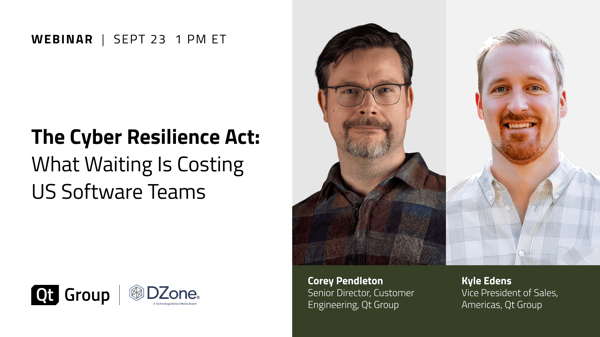
Webinar: The Cyber Resilience Act: What Waiting is Costing US Software Teams
Starting September 11, 2026, the EU Cyber Resilience Act (CRA) requires companies to report actively...
Watch Video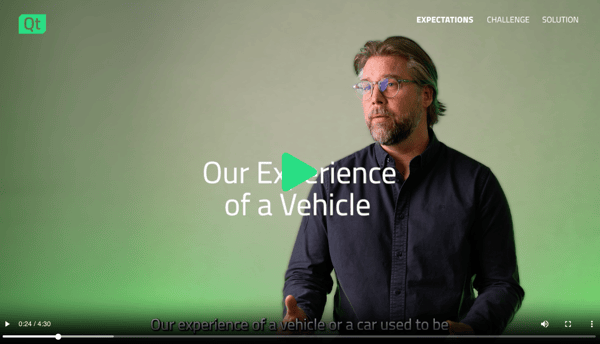
Video: The Making of The Outpace Project
Project Outpace – Qt's Reference Panoramic 3D Automotive Cockpit. Don't Choose Between The Design Yo...
Watch Video
On-Demand Webinar: CI/CD and Continuous Compliance of Embedded Software for Aerospace and Defense
Today, CI/CD for pure software products is well understood. But hardware dependencies and embedded d...
Watch Video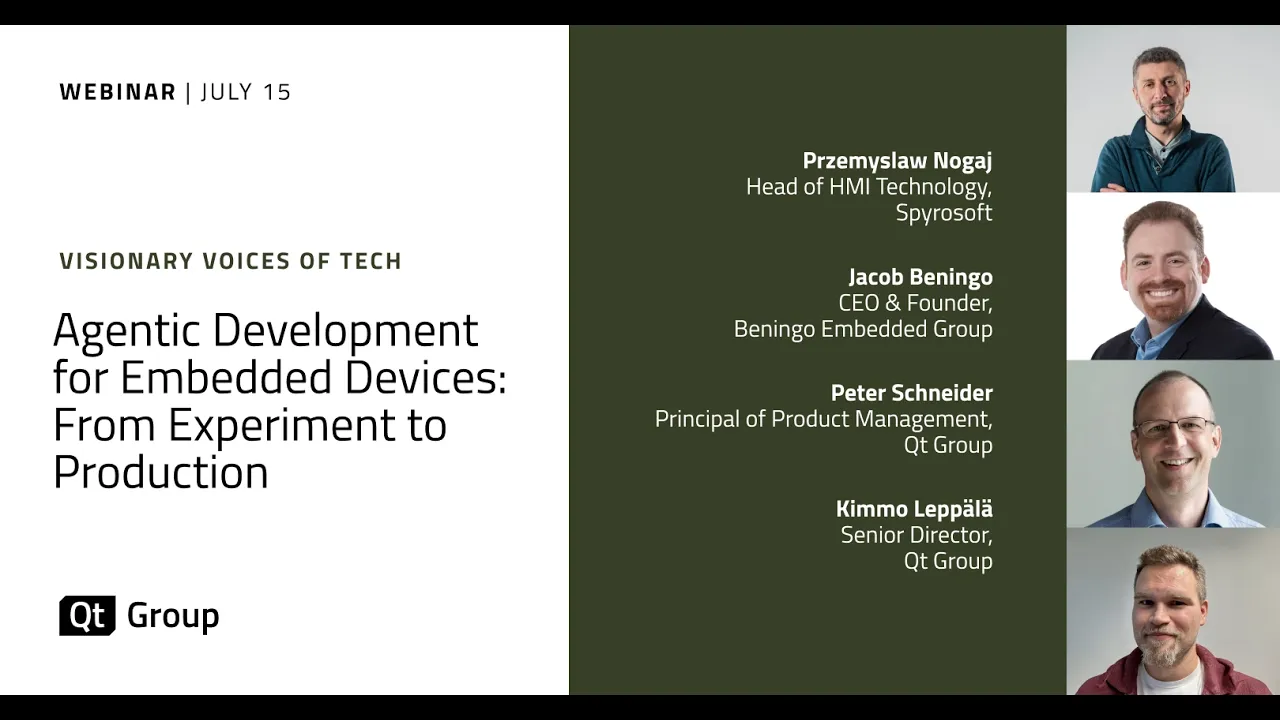
On-Demand Webinar: Agentic Development for Embedded Devices: From Experiment to Production
Agentic development for embedded devices is moving from experiment to production, and regulated indu...
Watch Video