
Bringing COTS to MOSA: Adapting the Qt Framework to the FACE® Approach
Qt Group adapted the Qt Framework to the modular open systems approach as the Qt for MOSA product. Qt for MOSA meets the FACE® Technical Standard and the FACE® verification process is complete. But, as COTS software, the Qt Framework was not written with FACE® Conformance in mind. This presented many challenges. It's a large existing codebase with extensive use of modern C++. Some of these language features are unavailable under the technical standard, while others pushed into untested corners of the CTS (Conformance Test Suite). The Qt Framework's API is extensive and too large to practically data model. Further, accommodation for the generalization of input and graphics devices was necessary. Solutions to these and other problems will be discussed with an intent to pave the way for future efforts bringing COTS software to MOSA.
Oh, here is more

Webinar: The Cyber Resilience Act: What Waiting is Costing US Software Teams
Starting September 11, 2026, the EU Cyber Resilience Act (CRA) requires companies to report actively...
Watch Video
Video: The Making of The Outpace Project
Project Outpace – Qt's Reference Panoramic 3D Automotive Cockpit. Don't Choose Between The Design Yo...
Watch Video
On-Demand Webinar: CI/CD and Continuous Compliance of Embedded Software for Aerospace and Defense
Today, CI/CD for pure software products is well understood. But hardware dependencies and embedded d...
Watch Video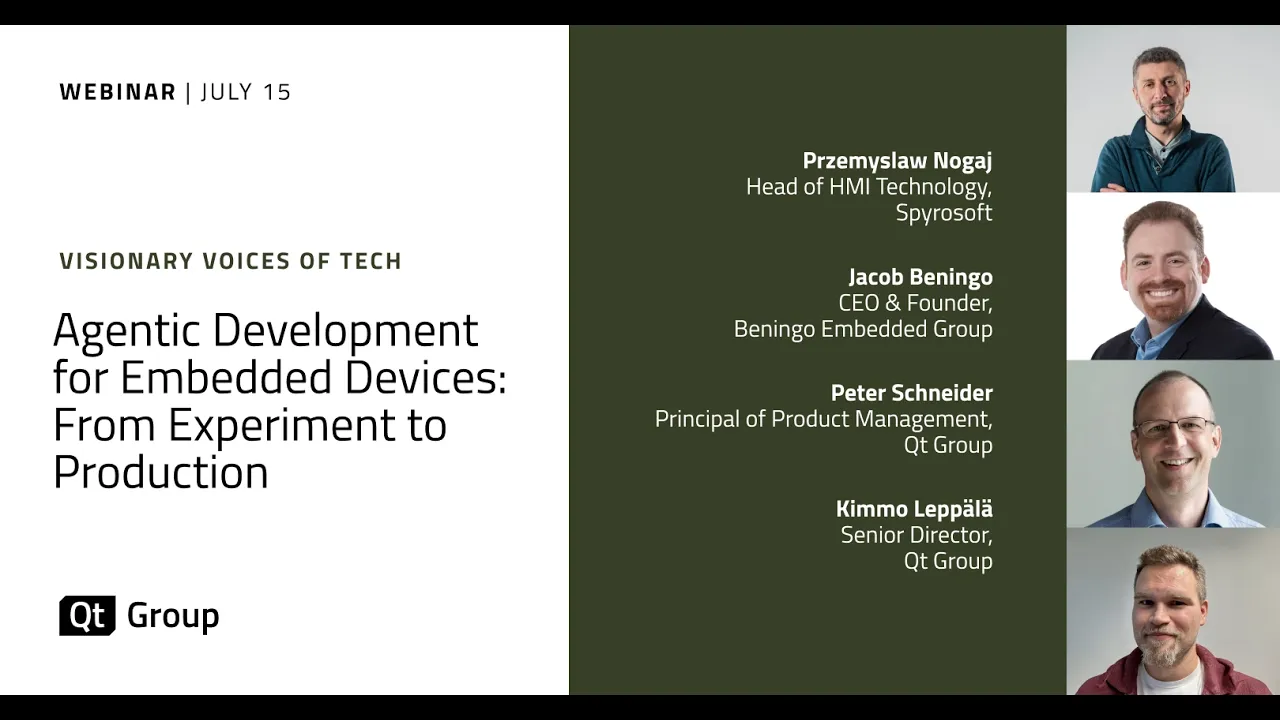
On-Demand Webinar: Agentic Development for Embedded Devices: From Experiment to Production
Agentic development for embedded devices is moving from experiment to production, and regulated indu...
Watch Video