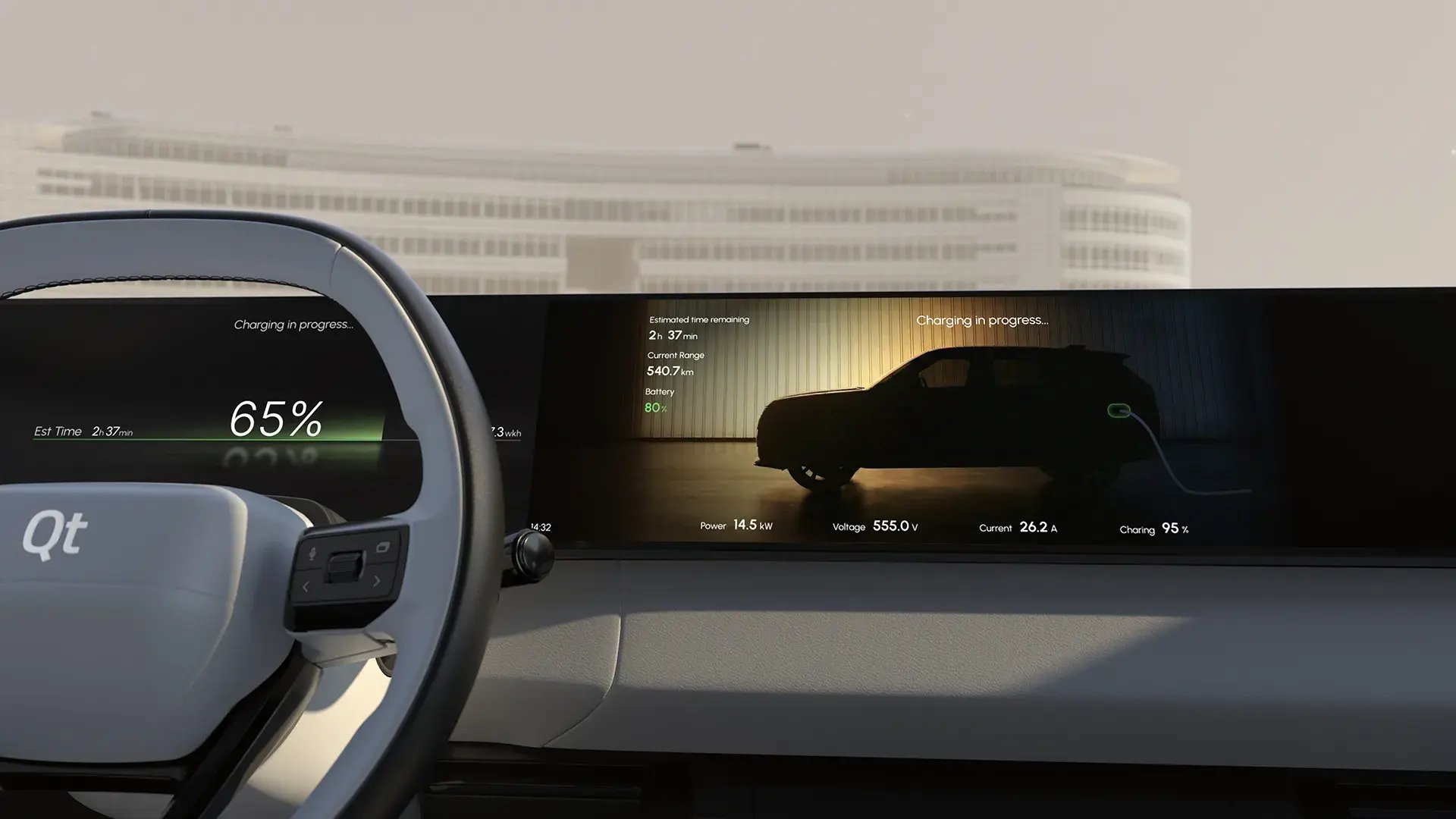
Outpace.
The Panoramic 3D Cockpit
Your Designers and Developers
Actually Want to Build
Outpace is Qt's reference panoramic cockpit —
a full pillar-to-pillar 3D experience running on mid-range automotive silicon, on Android Automotive, or any preferred OS to scale across programs.
.gif?width=1920&height=1080&name=Outpace%20video%20short%20(1).gif)

Don't Choose Between The Design Your Designers Drew and The One Your Program Can Ship
The in-vehicle experience's visual ambition has outrun the silicon budget.
Programs now want panoramic 3D throughout the cockpit with real-time transitions and ADAS visualization on the same dashboard. To reach a place where stunning visuals are possible, software teams in the automotive industry turned to game engines.
Game engines are powerful, yet they were built for PCs and consoles with dedicated graphics hardware. An automotive SoC shares silicon with the cluster, IVI, and ADAS. The mismatch shows up in production as RAM pressure, CPU contention, thermal limits, and safety architecture added late in the program.
We heard you, and Outpace is our response.
A full panoramic dashboard with immersive real-time 3D, running on mid-range automotive silicon. ISO 26262 in the architecture from the first prototype.
Break free from constraints that water down your in-vehicle experience.
A 3D Cockpit That Performs on Automotive-Grade SoC
Qt Quick 3D is built to render on embedded devices. In Outpace, it drives the full panoramic cockpit from one scene graph: photorealistic models, weather and terrain modes, day-to-night transitions, and the Surrounding Reality ADAS view.
All at the visual quality your designers signed off on, running even on mid-range automotive silicon.
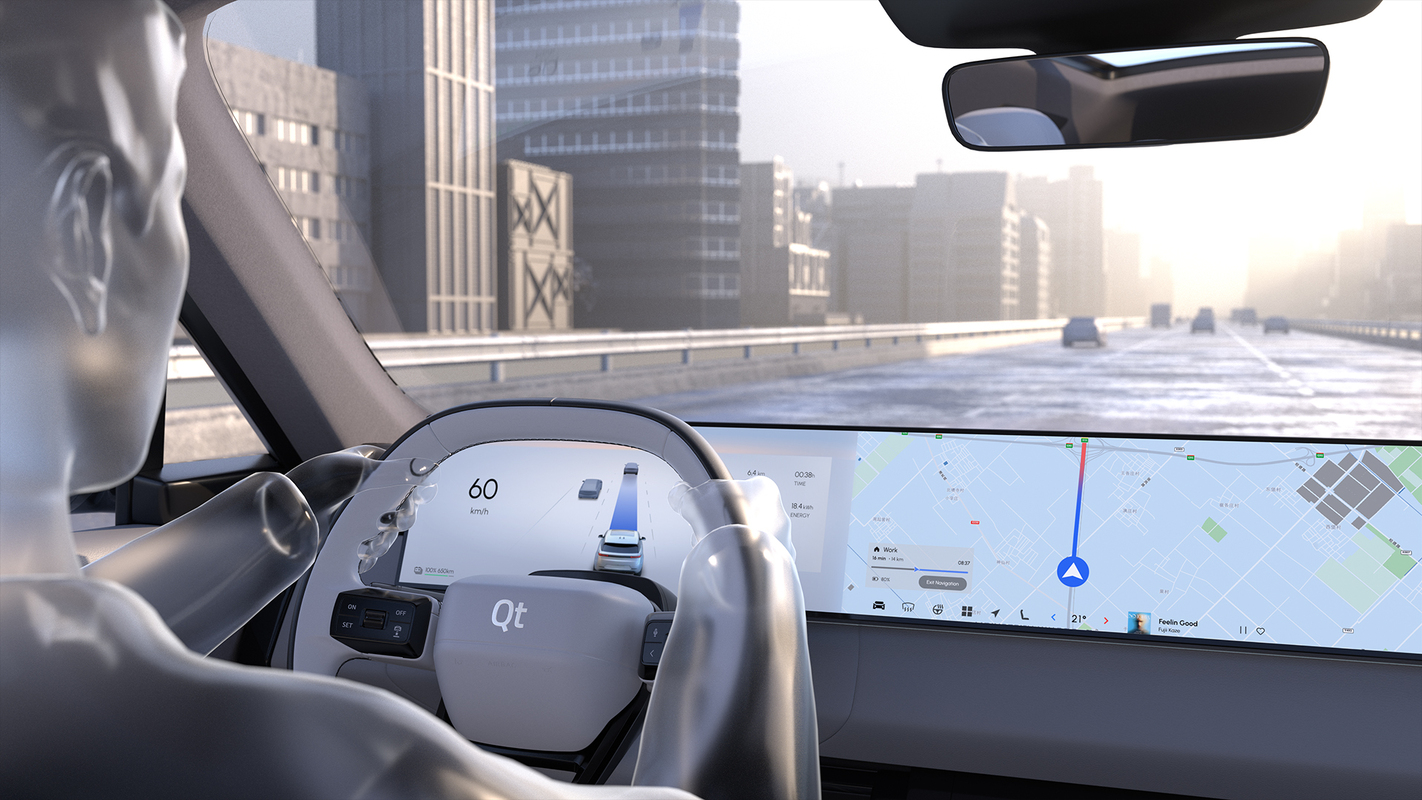
Switch Silicon or OS Without Rewrites
Outpace runs on Android Automotive today. The same cockpit architecture runs on QNX, on Linux, or any OS, and on the SoC families automotive programs actually use. The next platform decision doesn't force an HMI rewrite.
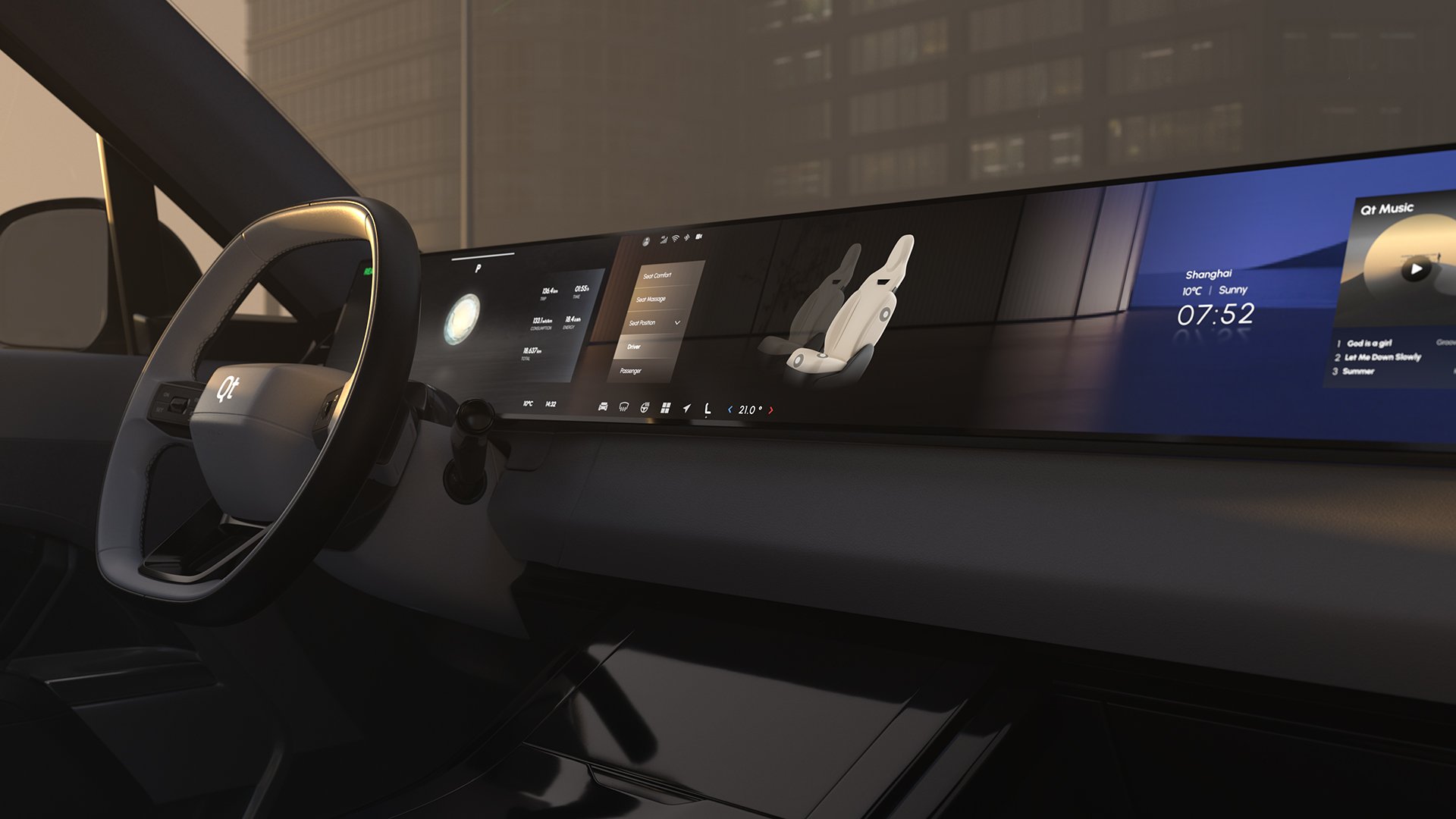
ISO 26262 From The First Prototype
Qt Safe Renderer is TÜV NORD certified to ISO 26262 up to ASIL-D, and it runs alongside Qt Quick 3D. In Outpace, cluster telltales, warnings, and lane and hazard visualisation render through the certified path. The rest of the cockpit renders through Qt Quick 3D.
Functional Safety is built into the architecture from the start, bringing your team more peace of mind.
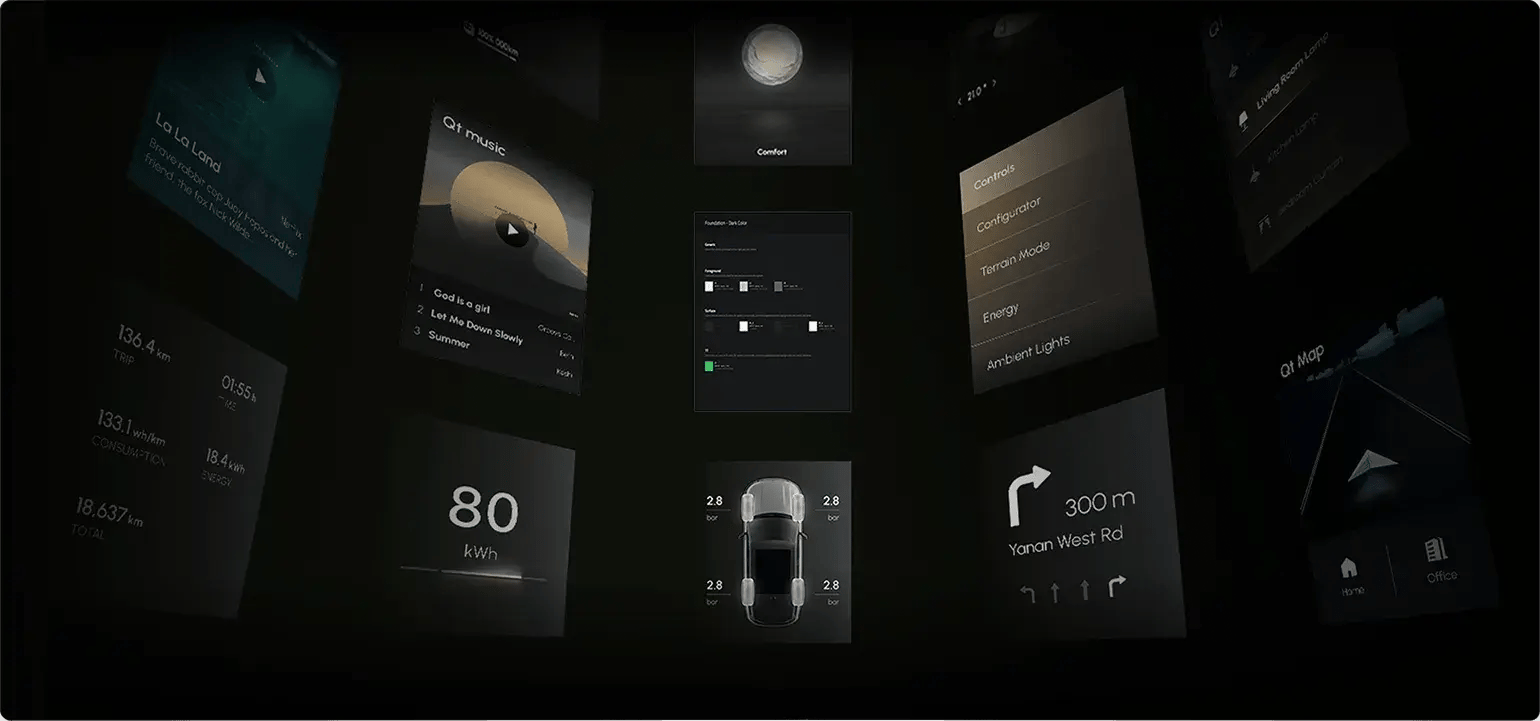
Outpace on Real Hardware
40%
Less RAM
than leading 3D-engine alternatives
50%
Less CPU Utilization
than leading 3D-engine alternatives
A Panoramic Reference, Designed to Scale
Outpace runs on a 44.1-inch panoramic mini-LED at 7680 × 936 resolution.
The layout shows what the next generation of automotive cockpit programs has to plan for:
driving information, ADAS fused into the main UI, navigation, entertainment, and brand identity coexisting on one continuous ultra-wide display.
The reference scales down as well as up.
Adapt the same architecture to a single curved cluster, a three-screen split, or a smaller panoramic.
Current Project Specifications
Current project specifications
Operating system: Android Automotive
Board: MediaTek MT8676
Qt modules: Qt Quick 3D, Qt for Android Automotive, Rendering as a Service
Outpace runs on the specs above today.
The same architecture runs on other SoC families and operating systems.
Customers adapt it to their own program.
High-Performance 3D Graphics
Qt Quick 3D renders the full scene at real-time frame rates on Android Automotive. Rendering as a Service serves the same 3D assets to every screen from one pipeline, so the graphics footprint doesn't grow with each new application.
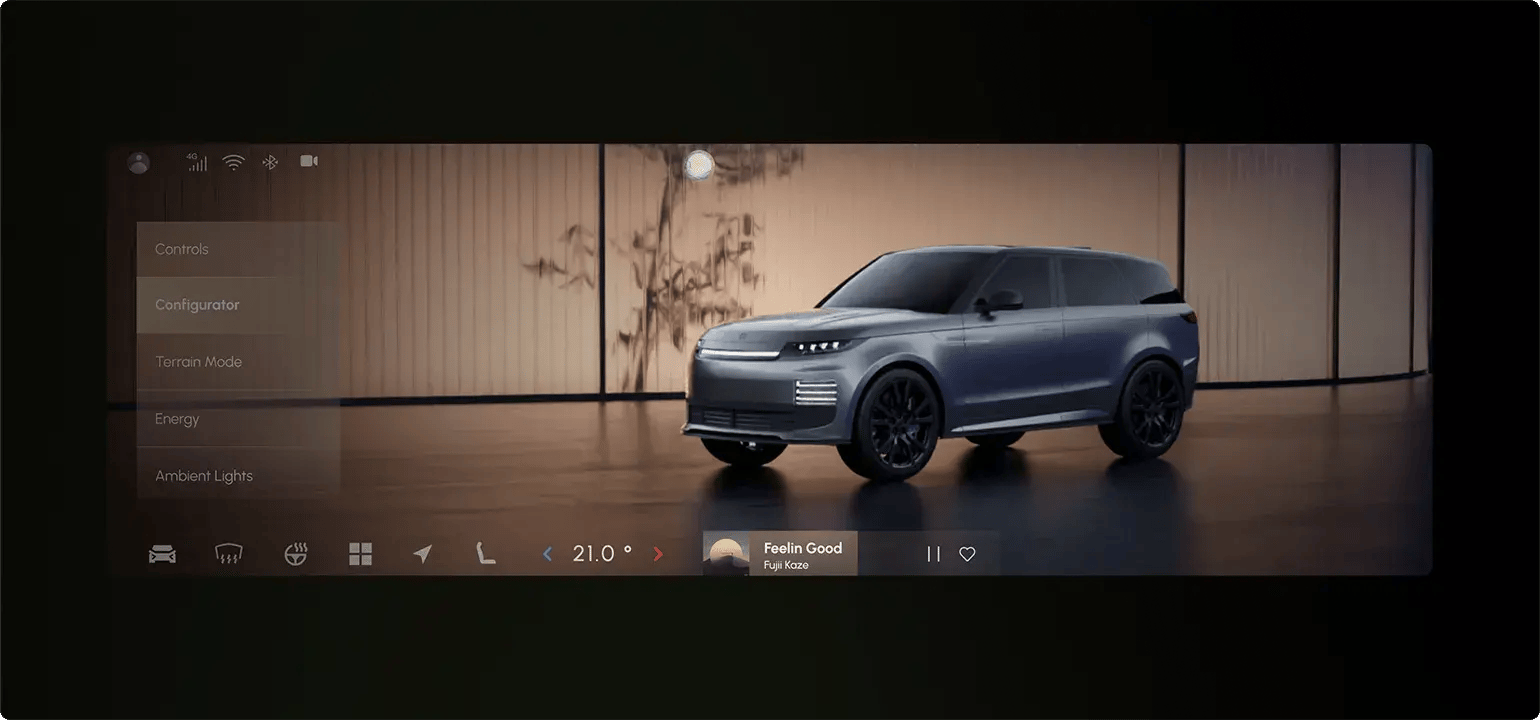
Your UX On Any Automotive Platform
Outpace runs on Android Automotive, but it scales to run on Linux, QNX, and all other operating systems automotive programs use. Keep full control over visual identity, 2D and 3D design, and a consistent experience across displays.
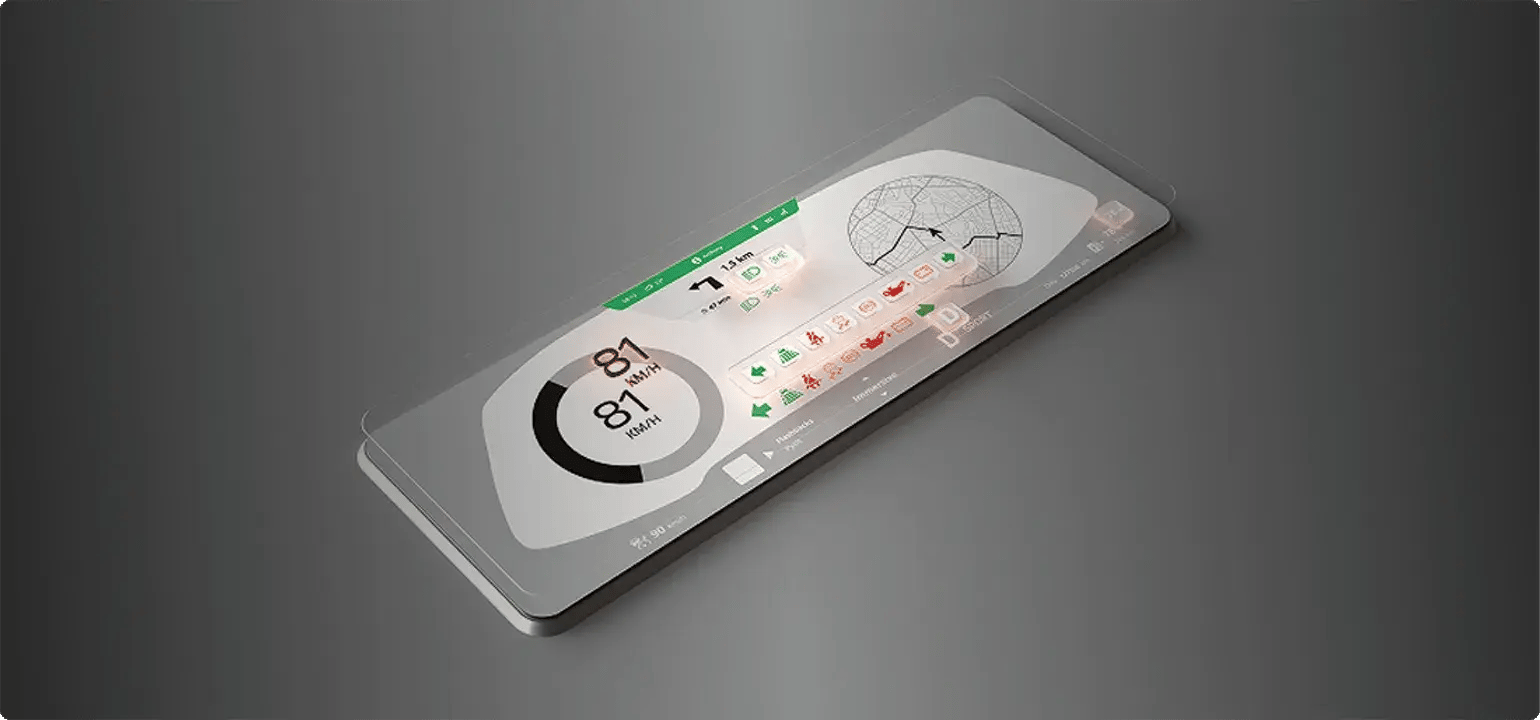
Certified Safety Rendering
Qt Safe Renderer is TÜV NORD certified and built for ISO 26262 ASIL-D. It runs alongside Qt Quick, and safety-critical elements render reliably on the same hardware, saving on the BOM costs.
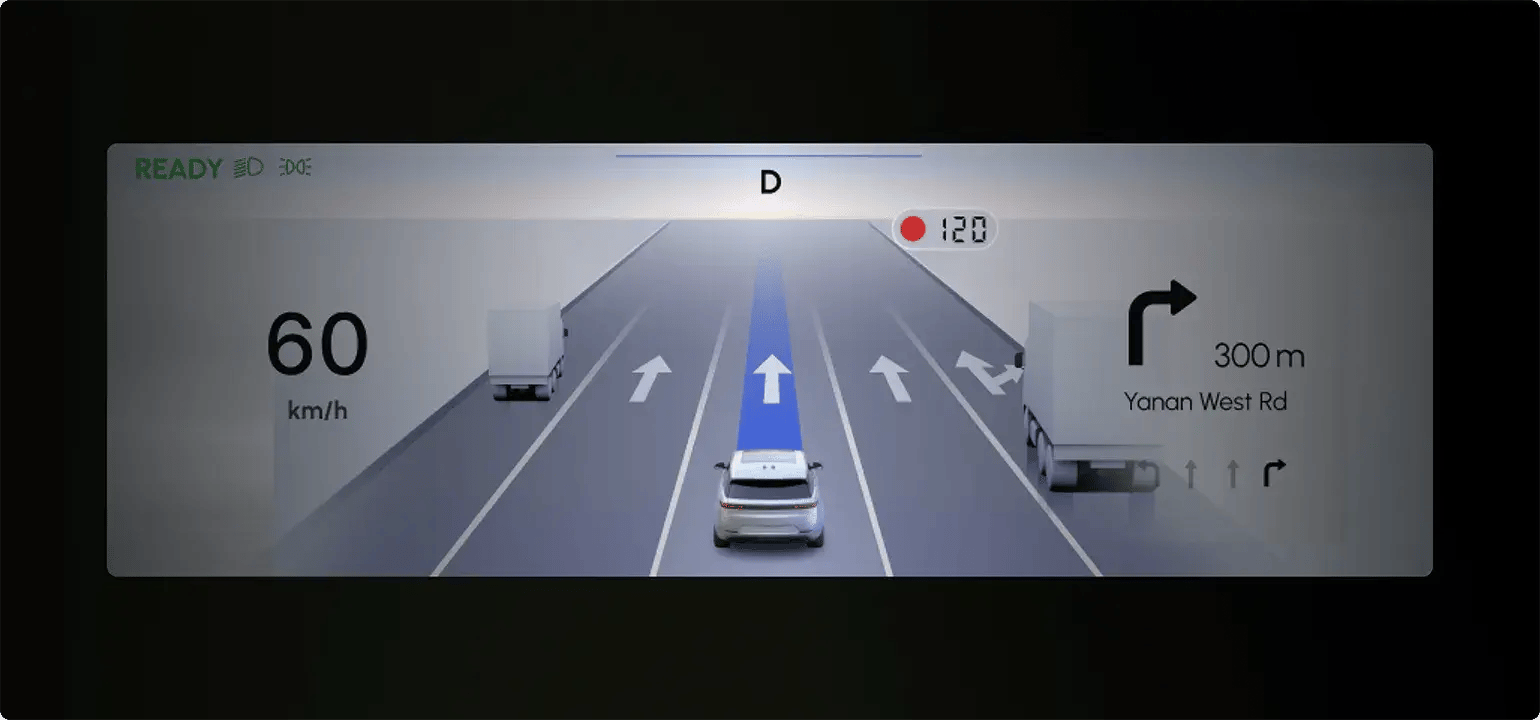
Production-Ready ADAS
The Qt Surrounding Reality (SR) HMI Template is distributed as white-box source code. Programs use it as a tested foundation for 3D ADAS visualisation and skip rebuilding the sensor-fusion and lane-detection plumbing for each new vehicle.
Openness
Performance
Scalability
Qt Framework provides an open and flexible foundation for next-gen automotive software, enabling OEMs to create distinctive in-vehicle experiences while maintaining full control over their technology stack.
See Outpace on your program.
Talk to our automotive team about what Outpace looks like based on your needs and your safety requirements.
Book a Demo to Try it Out
FAQ
Check our Frequently Asked Questions to learn more about how Outpace it works.
Can you build a panoramic 3D cockpit on mid-range automotive silicon, or do you need a flagship SoC?
Yes, on mid-range silicon. Outpace runs a full pillar-to-pillar 3D cockpit on a MediaTek MT8676, a mid-range automotive SoC rather than a flagship board. Qt Quick 3D is built to render on embedded devices. Photorealistic models, weather and terrain modes, and ADAS visualisation run from one scene graph at real-time frame rates while the same chip still serves the cluster, IVI, and ADAS.
How do you meet ISO 26262 functional safety in a 3D automotive cockpit?
Through a separate, certified safety system that stays isolated from the main cockpit.
Qt Safe Renderer renders the safety-critical content, including cluster telltales, warnings, and lane and hazard visualization, on its own isolated system. That can be a dedicated RTOS, on separate hardware if the program needs it, or its own container on a hypervisor. The safety layer and Qt Quick 3D never share a rendering pipeline. What they share is the display output, composited onto the same screens.
Qt Safe Renderer is TÜV NORD certified to ISO 26262 up to ASIL-D. This way you avoid late-program retrofits as the safety path is designed in from the first prototype.
Can one cockpit UI run on Android Automotive, QNX, and Linux without rewriting it?
Yes. The UI is built from the same QML components, so the look and the brand identity carry across every screen and across platforms without being rebuilt. Outpace runs on Android Automotive today, and the same cockpit runs on QNX, on Linux, and on the SoC families automotive programs already use. The next operating-system or silicon decision doesn't force an HMI rewrite, so the experience you design once follows the program across platforms.
Does Qt replace Android Automotive, or build on top of it?
You don't have to replace Android Automotive. Qt isn't tied to it.
For this project, Qt was built on top of Android Automotive. The native AAOS services stay in place, including media, maps, connectivity, and apps, and Qt handles the cockpit's 3D and visual design. That is the configuration Outpace ships in.
Within an Android Automotive program, how you split the work is up to you. Qt can deliver the full 2D and 3D experience, or you can keep Android Automotive for the 2D and use Qt for the 3D, whichever you prefer.
If a program would rather not run Android Automotive at all, Qt runs natively on Linux and QNX, and the same cockpit goes there too. The choice of operating system stays yours.
What are the alternatives to a game engine for an automotive 3D cockpit?
The practical alternative is a rendering stack built for embedded automotive silicon instead of for gaming. Our answer to that is Qt Quick 3D.
It matches a 3D engine on screen and beats it in production and over the program's life. With Outpace, we proved it renders the full panoramic dashboard on a mid-range automotive chipset, at the quality your designers signed off on and on less RAM and CPU than leading 3D-engine alternatives.
Certified ASIL-D safety rendering runs alongside, and the same cockpit ports to Linux, QNX, and other OSs without a rewrite.
What is Outpace, and what hardware and operating system does it run on?
Outpace is Qt's reference panoramic cockpit, a full pillar-to-pillar real-time 3D in-vehicle experience on a 44.1-inch panoramic mini-LED at 7680 × 936.
Its reference configuration runs on Android Automotive on a MediaTek MT8676, using Qt Quick 3D, Qt for Android Automotive, and Rendering as a Service, with Qt Safe Renderer for the certified safety layer.
The same architecture scales to other SoC families and operating systems, and down to a single curved cluster or a three-screen split.
Customer Stories Written with Qt
Volkswagen and Desay SV used Qt to reduce memory consumption by 50% on the 5-inch screen of the VW California campervan.
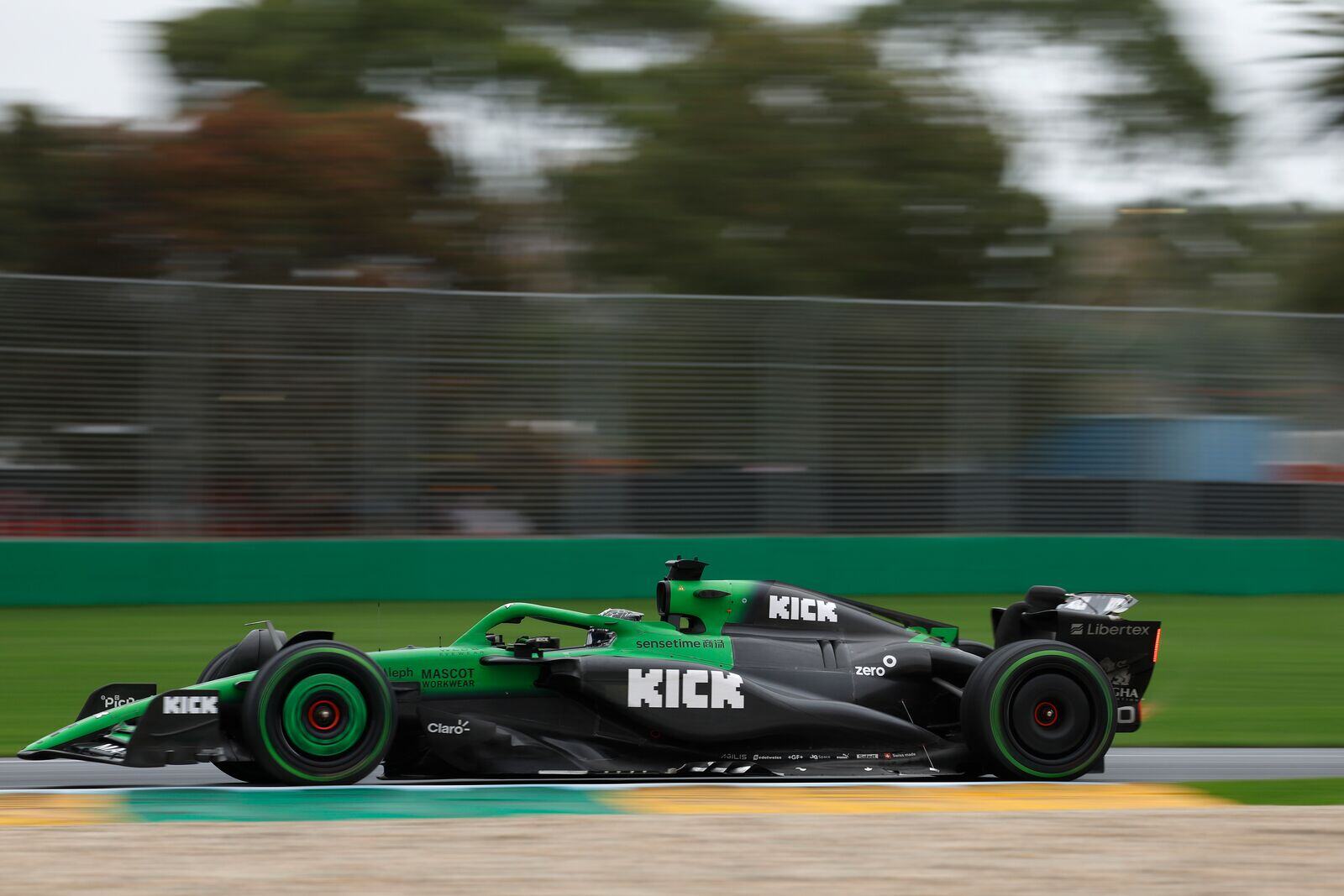
Sauber uses Qt to boost efficiency and safety during pit stop in Formula 1 races, and in several other applications.
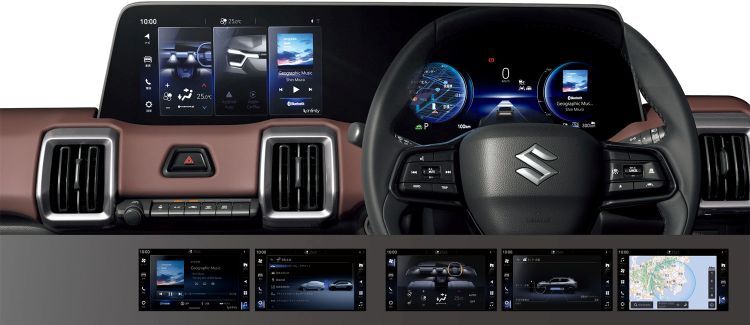
Leverage Qt fully data-driven real-time rendering capabilities to disclose road information by means of non-distracting augmented reality visuals.
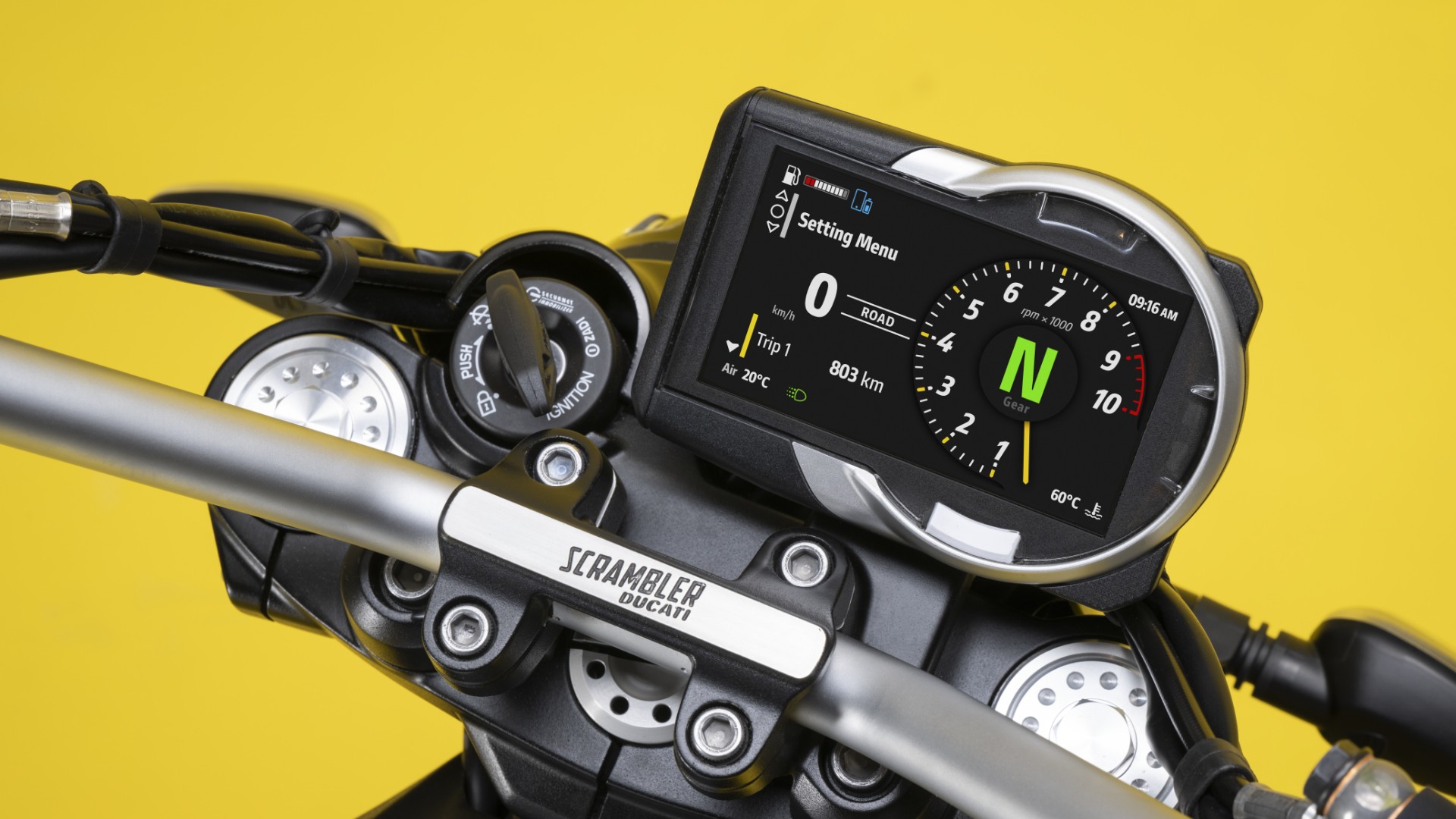
Ducati uses Qt for high-performance, smartphone-like HMI graphics, crucial for their luxury motorcycles.
Upgrading to Qt 6 to support MB.OS across cars, leveraging cross-platform development, and shortening time-to-market.
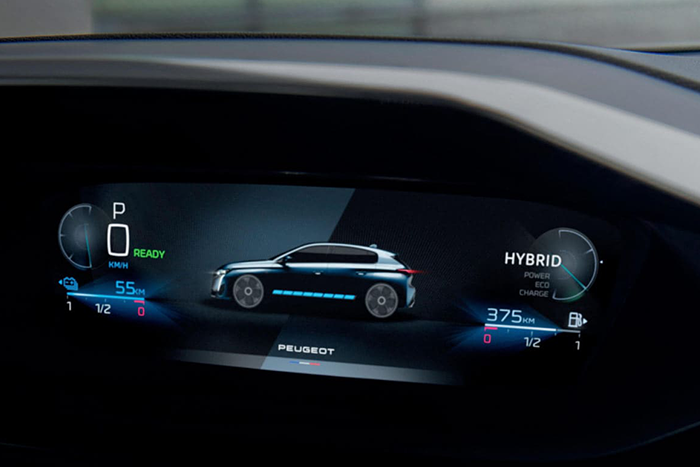
Stellantis uses Qt for rapid prototyping and cross-platform HMI development with advanced 3D effects.
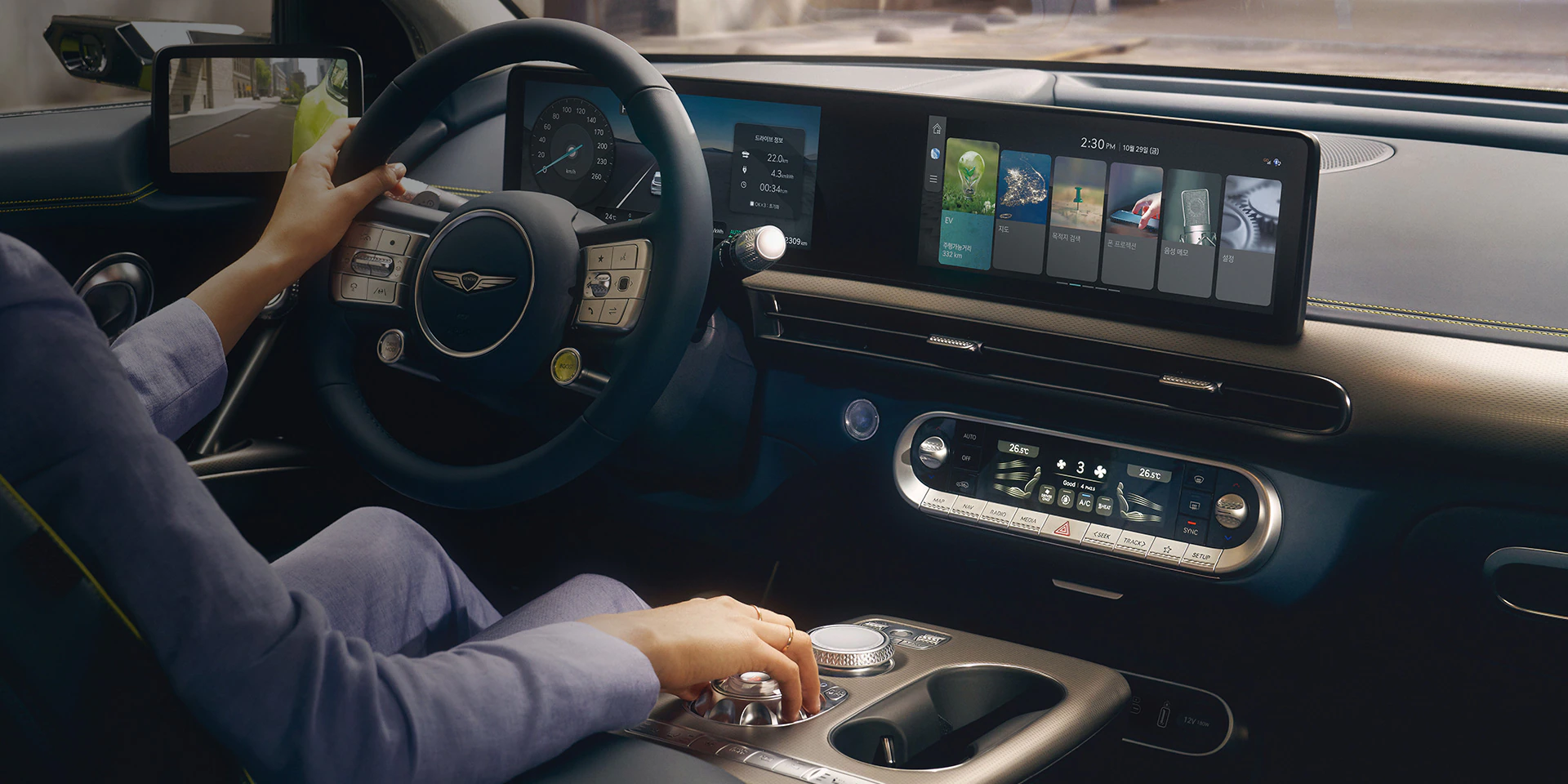
Qt is the key HMI partner for Hyundai, Kia, and Genesis, streamlining development and maintenance.
Koenigsegg leverages Qt for supercar development, valuing its professional framework.
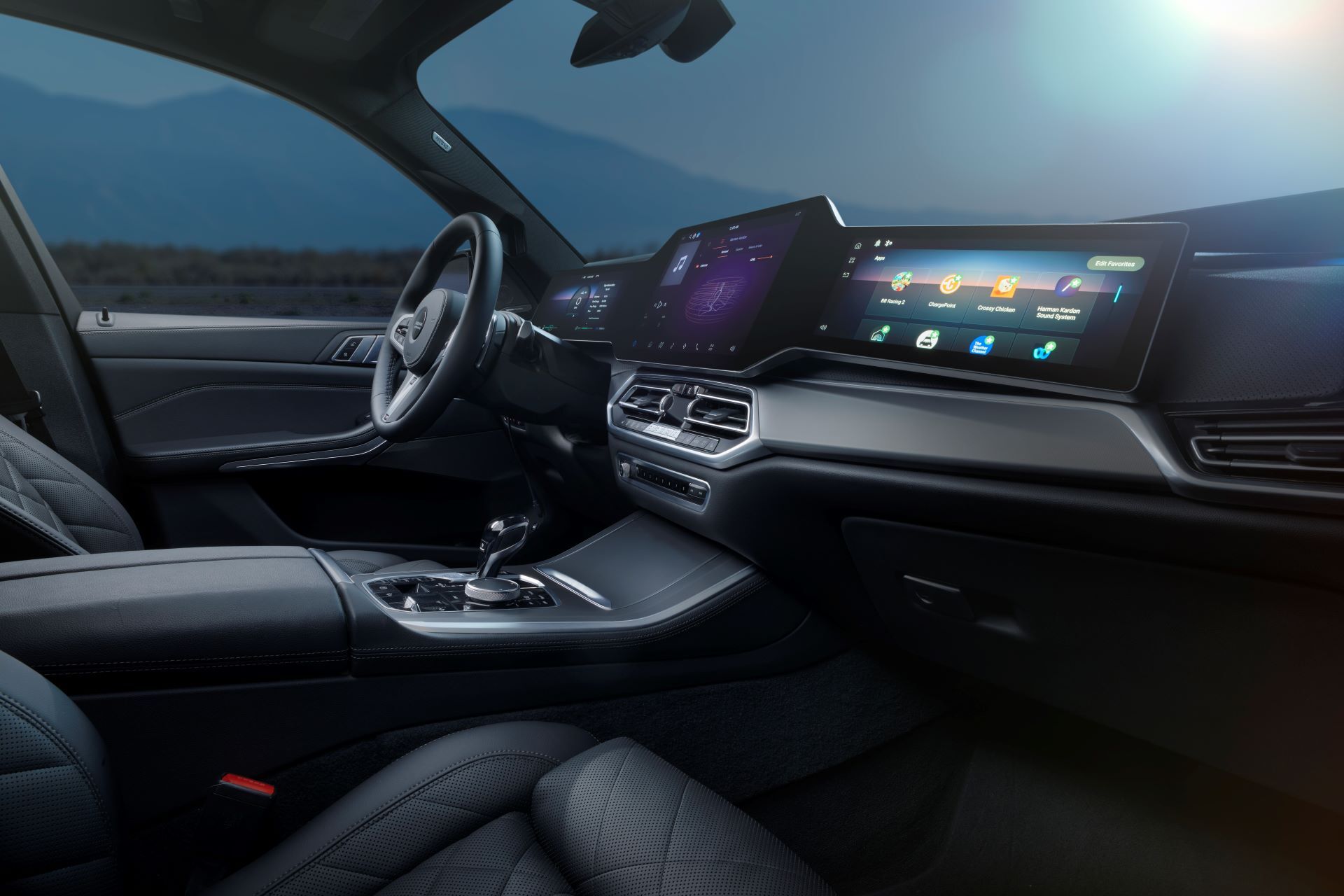
Harman uses Qt Framework as an accelerator to unlock competitive advantages and highly customized solutions.
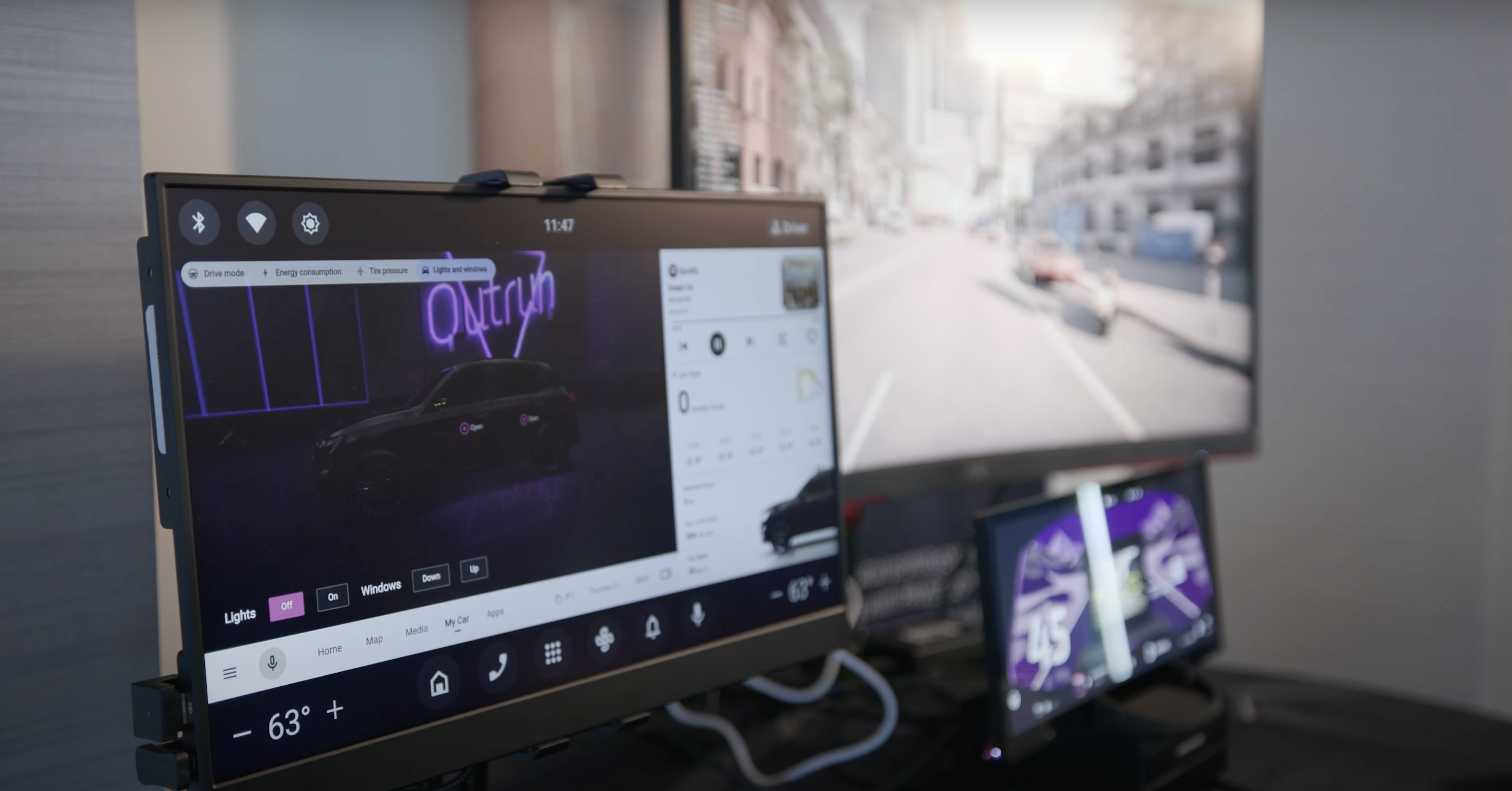
In partnership with Qt Group, Siemens uses Qt Automotive HMI to bring its digital twin solution PAVE360™ to life with interactive visuals and rich functionality.