AI dominated embedded world North America 2026. Every major silicon vendor had an AI story to tell. But when I talked with engineers, the questions changed. Few asked whether AI can run on embedded hardware. They wanted to know how to deploy it, debug it and support it for 10 years or more.
Key Takeaways from embedded world North America 2026
- Embedded AI has moved from experimentation to deployment.
- Physical AI demands better observability and debugging.
- Toolchains decide whether AI projects succeed.
- Quality and compliance are now continuous, driven by the Cyber Resilience Act (CRA).
- 10- to 20-year lifecycles are changing how pipelines are built.
- Zephyr, RISC-V, CMake and CI/CD keep gaining ground.
Has Embedded AI Reached the Mainstream?
Yes. STMicroelectronics, NXP, Infineon, Microchip, Renesas and NVIDIA showed AI across vision, sensor fusion, robotics and local inference. What stood out was the maturity of the questions. A few years ago, people asked whether AI could fit on constrained devices. Now they ask how to optimize models for production, fit them within memory and power limits, and debug them on real hardware. The challenge is no longer proving AI works. It is keeping it working.
What is Driving the Rise of Physical AI?
Systems that act on the world, not just report on it. Sessions covered robotics, autonomous systems and vision-language-action models. Unlike traditional Edge AI, Physical AI drives actions and decisions, so developers need to see how software, models, middleware and hardware interact. Success takes more than compute. It takes strong debugging and system observability.
Why is Shipping Edge AI Harder than Building a Demo?
Because shipping is decided by the toolchain, not the model. This was the focus of my session, "Edge AI Is Easy to Demo and Hard to Ship: Toolchains Decide Who Succeeds." Most AI discussions focus on models, frameworks and benchmarks. The engineers responsible for shipping products wrestle with:
- Memory constraints
- Compiler optimization
- Debugging deployed systems
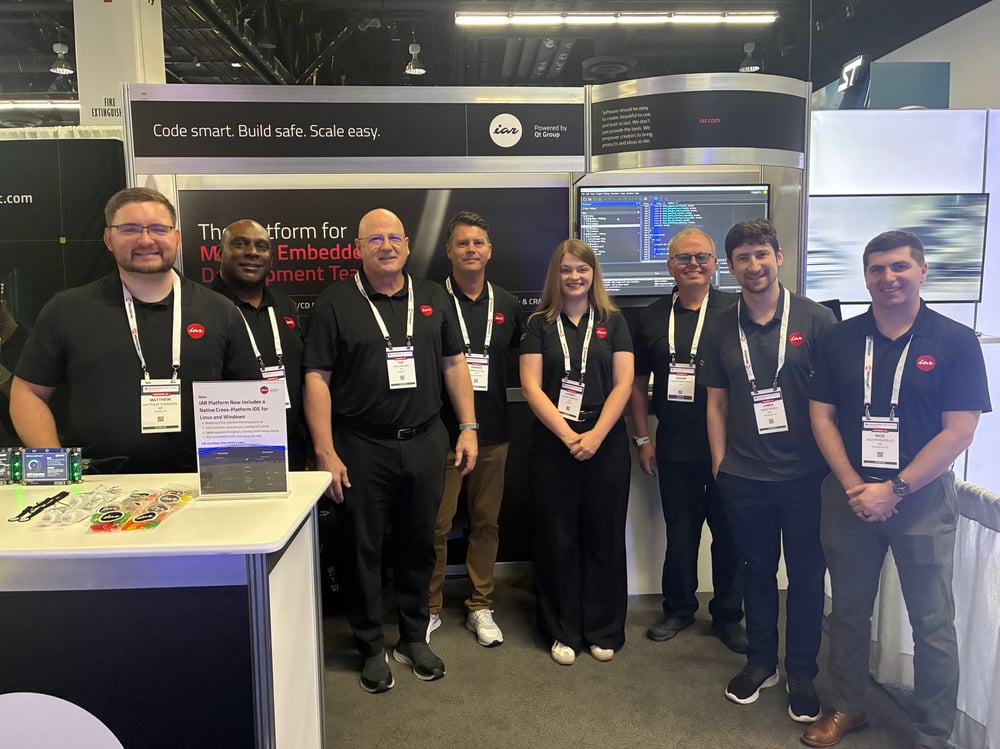
These are engineering questions, not AI questions. After the session, attendees followed me to the IAR booth to keep talking, and their questions were about compliance, debugging and visibility, not model performance.
Why Are Software Quality and Compliance Becoming Continuous Activities?
Because teams have stopped asking whether the CRA applies and started asking how to implement it. Discussions centered on static analysis, MISRA and CERT compliance, traceability and Software Bills of Materials (SBOMs). Teams want feedback while code is being written, not weeks later in validation. Compliance is less about passing an audit and more about showing control throughout a product's life.
Why Are 10-year Product Lifecycles Reshaping Embedded Development?
Because many products outlive the software environment used to build them. Industrial, medical and transportation products commonly stay in service for 10 to 20 years. That was the theme of my session, "You Will Be Maintaining This Firmware for 10+ Years: Design Your Pipeline Accordingly." Most pipelines are built to ship a product, not to support the decade after. Long-lived products need:
- Reproducible builds
- Stable, certified toolchains
- Automated testing
- Traceable processes
For safety-critical products, that often means functional safety (FuSa) certified tools, kept stable for as long as the product is supported. Attendees' top concern was staying consistent through years of updates, team changes and product generations. With the CRA extending responsibility past launch, lifecycle management is becoming a competitive advantage.
Why Are Developers Embracing Zephyr, RISC-V, and Modern Workflows?
Because they want modern software workflows without giving up embedded performance and quality. Interest was strong in Zephyr RTOS, RISC-V (including FPGA-based systems), native CMake support, CI/CD, containerized development and open standards.
What Did Developers Want from Their Embedded Development Tools?
Modern workflows with professional-grade reliability. Demos of the new cross-platform IAR Embedded Workbench IDE drew strong engagement, especially from teams standardizing on Linux and Windows with a common toolchain from development through automated builds.
Looking Ahead
AI generated the excitement, but the best conversations were about deployment, debugging and maintainability. The next challenge is building devices that can be maintained and updated over decades, not months.
That starts with the toolchain and the pipeline around it. See how IAR's platform brings reproducible builds, static analysis and debugging into one workflow, from the developer's desk to CI.