Jul 1, 2026
Comments
Qt Bridges is a project we have been developing since 2025 to bring Qt’s UI framework capabilities to other programming languages, without going through the full set of bindings. The focus is on the interaction with backend data objects, seamlessly integrated as QML components in a Qt Quick interface.
Since the announcement back in QtWS2025, we have been working to develop our initial proof of concept to a point where our users can give it a try. Today we are very happy to announce that we’re ready to move to public beta with our second language, Rust, as it’s in good shape for you to try it out.
This milestone includes the following features:
- Create Rust structs as QML elements
- Invoke Rust methods from QML
- Handle Rust signals in QML
- Read and write Rust properties in QML
- Bind QML properties to Rust properties
- Bind QML views to Rust collections
- Build and interact with the QML object tree form Rust
- Cross-thread method invocation
- Direct support of serde_json
- Write backend code in idiomatic Rust, without writing any C++ code.
Learn how to start using Qt as your next Rust UI framework, try it out, and send us your feedback.
Why Rust?
Not all language adoption follows the same path. Some languages grow through widespread use across many domains; others earn their place through deep trust in specific, demanding context. Rust is firmly in the second category, and those contexts happen to overlap significantly with where Qt is the most at home. While Rust is not rocketing the statistics in terms of usage, it found a strong and loyal community of admirers.
|
|
Rust at 20th place on the RedMonk Rankings Q1 2026. Click the image to enlarge. |
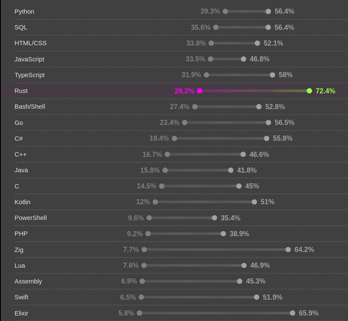
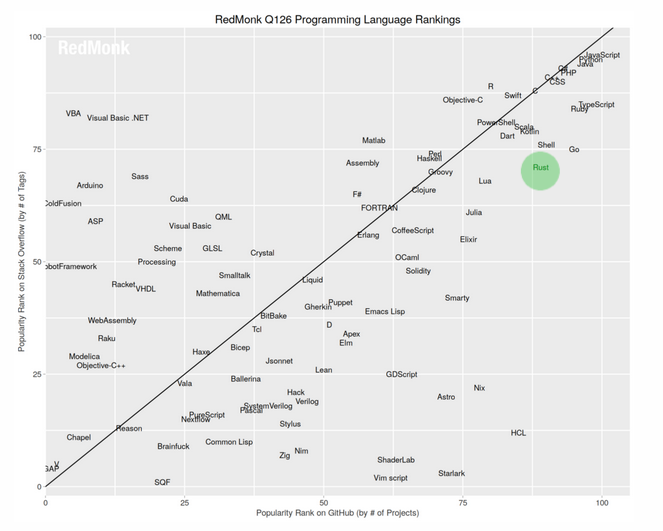
On the Stack Overflow Developer Survey 2025, Rust stands out not for raw usage but for something rarer: it has been the most admired programming language for 10 consecutive years (2016-2025), with 72% of its users wanting to continue using it. No other language holds that record. Cargo, Rust’s build tool and package manager, independently ranked as the most admired developer tool (71%) in the same survey. On the RedMonk Ranking Q1 2025, Rust sits at the 20th place, with clear upward trend from outside the top 20 just a few years ago, a trajectory that reflects deliberate, growing adoption rather than hype.
The crates.io registry, which hosts Rust packages, now serves over 1 billion downloads per day across more than 200,000 published crates, numbers that speak to a thriving and active ecosystem.
What sets Rust apart as a Qt Bridges candidate, however, is where and why it is being adopted. Rust is explicitly designed as a safe, modern replacement for C and C++, the very languages Qt was built on and that the majority of Qt developers use today. This has driven adoption at the infrastructure level: AWS, Google, Microsoft, the Linux Kernel project, and others have all made strategic investments in Rust for performance and safety critical code.
In 2024, the Safety-Critical Rust Consortium was formed specifically to drive Rust adoption in automotive and aerospace contexts, industries that are already significant for Qt users. Governments and standards bodies, including the US NSA and CISA, have also formally recommended Rust as a memory-safe alternative to C and C++ critical systems.
This means that many developers and organizations already working with Qt in C++ are not merely curious about Rust, they are actively being pushed toward it by industry requirements, regulatory guidance, and the practical needs of building safe, reliable software.
What’s Next?
Try it out and share your feedback with us. Start from the dedicated blog for more details and instructions on how to use Qt as your new Rust UI framework.
The next step for our Rust bridge is to reach a Technology Preview (TP) state, where we will refine and complement the current offering. Your feedback is very valuable for reaching this milestone, so we hope to hear from you.
Use the Qt Bridges Forum for any related discussions, as well as our bug tracking platform (JIRA) to report issues that you may find once our TP is released.
Future Qt Bridges Releases
Rust is part of the first phase of the project together with C#. Once the bridging for these languages reaches the maturity we are aiming for, we will continue with the second phase that will include new languages.
Blog Topics
Related Articles

Implementing Tracepoints in Qt Applications using Qt Creator 21
Sometimes, as a developer, you need to find out why your application is..
Read Article
Qt Creator 21 Beta released
We are happy to announce the release of Qt Creator 21 Beta! You find a..
Read Article
Introducing the Canvas2D Coding Skill for Agentic Development of Embedded Device UIs
The Challenge: Getting AI Agents to Draw Correct Canvas2D Qt 6.12..
Read Article