Published On
Jul 31, 2026
Read Time
7 mins
The Quiet Gap No Dashboard Shows
Right now, your dashboards probably look great. Output is up. Your team is shipping faster than it used to, and a lot of that speed comes from AI writing code, suggesting tests, and drafting documentation. On paper, this is exactly what you wanted.
But there's something underneath the numbers that no chart really captures. A gap between how fast you're moving and how sure you are about what you're sending out the door. And it widens with every sprint.
When the work is safety-critical, it's the thing about AI worth understanding right now.
AI Arrived on Two Fronts at Once
If you lead development in automotive, medical devices, or aerospace, AI showed up in your world twice at the same time.
The first front is your product.
The market wants AI features with systems that perceive, algorithms that adapt, and automation that makes its own calls. Since your competitors are already selling this, waiting it out isn't a strategy.
The second front is your team.
Your engineers are already using AI to write code whether or not there's a policy about it. Productivity went up. Telling people to stop isn't realistic, and it would be the wrong call anyway.
So you're not choosing whether to adopt AI. That choice was made for you. The real question is whether the way you check your software today can handle both fronts at once.
AI Doesn't Create the Problem. It Speeds up the One You Have.
Here's the part most people get backwards. AI doesn't introduce a new kind of failure into your codebase. It takes the one already there and accelerates it.
Think about how your engineers spend their day. Roughly half of all development time goes into understanding existing code before anyone changes a line. It's also known as the understanding tax, and every engineer on your team pays it daily.
Now add AI to that:
If your architecture is verified and your coding standards are enforced automatically, AI-generated code lands inside structures your people already understand. That cost stays flat, and AI becomes a real accelerator.
Flip the conditions and you get the opposite:
If your architecture lives in a slide deck from two years ago, and your standards depend on whoever happens to review the work that day, AI-generated code piles onto complexity that was already hard to follow. Code that took minutes to write can take hours to decipher. The cost of understanding your own system climbs.
Same tool. Opposite outcomes. The only difference is the foundation underneath it.
That's what "amplifier" means here. AI has no opinion about your codebase. It simply makes the direction you were already heading happen faster.
What the Slow Collapse Looks Like
Software erosion follows a predictable curve with three phases.
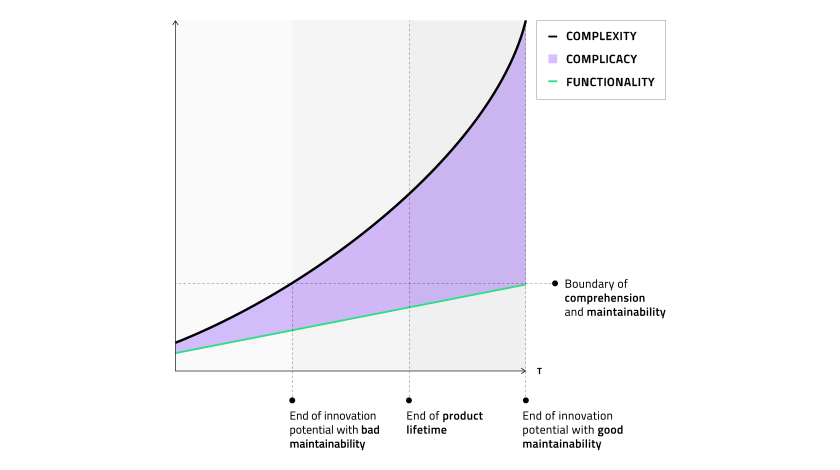
Phase one is manageable
You have technical debt, but it's navigable. Shortcuts exist and nobody loses sleep over them. Teams keep their pace.
Phase two is where it turns
Complexity grows faster than anyone can keep up with. Every change needs more investigation than the last one. This is where AI does the most damage on a weak foundation because it adds bulk to the codebase faster than your team can absorb it.
Phase three is collapse
Nobody can touch the code with any real confidence that it's safe. This is how good products end. Not because customers left, but because the software stopped being able to change.
If you build physical autonomous systems that operate in the real world, phase two becomes a liability. And phase three can mean a recall or a regulator at your door.
The False Choice Almost Everyone Makes
When AI arrived, most organizations picked one of two bad responses.
Option 1: Paralysis
They locked AI down to protect compliance and told themselves they were being careful, while competitors pulled ahead and the market moved on without them.
Option 2: Recklessness
They embraced AI, celebrated the speed, and assumed their existing process would stretch to cover it. It didn't.
Verification work piled up unnoticed in the background, and risk accumulated faster than any human-only team could have managed.
Both responses rest on the same assumption. They assume you have to trade speed for safety.
You don't. There's a third path, and it starts with a sharper question: which kind of fast are you actually buying?
Speed from cutting corners borrows against your future. Every sprint that skips checks hands you work that returns later and bigger. Speed from trusted systems compounds the other way. Every investment in checking your software pays out on every release that follows.
AI amplifies whichever one you picked.
Four Signs Your Foundation Won't Hold
You don't need a consultant to tell you whether your foundation is fragile. Here are four warning signs, and most leaders recognize at least one right away.
1. A backlog you can't see
Development speeds up while checking doesn't. The distance between finishing the code and being able to release it grows every sprint. It never appears on a dashboard but it appears the week you try to ship and discover how much work still sits between "done" and actually done.
2. Every small change forces you to retest everything
AI suggests a clean little fix. But without a verified architecture, you can't prove the change stays where you put it. A modification that might touch anything forces you to test everything. A job that should take days now takes weeks, and your AI productivity gains disappear into rework.
3. Audit evidence has become archaeology
When auditors are coming, does your team start digging? Hunting down documents, checking whether they still match the code, rebuilding the paper trail that links requirements to design to tests. That's weeks of manual work for something that should be a report you generate on demand.
4. The architecture lives in someone's head
A senior engineer knows how the system fits together, which parts are allowed to talk to which, and why. Ask whether anyone can demonstrate that one component is incapable of touching another.
If the room goes silent, your safety boundaries exist as shared memory rather than as code. AI has no access to what's in your best engineer's head, so it will cross those boundaries and make the code work anyway.
One Boundary, and Why it Matters so Much
Say your architecture states that Component A must never call Component B. That isn't a style preference.
Under a safety standard like ISO 26262, that boundary might exist because A is a low-criticality part and B is one of the most safety-critical parts in the system. The two are kept isolated so a fault in the first can't compromise the second.
This is known as freedom from interference.
But an AI assistant knows none of that. AI optimizes for one thing which is to make the code work.
If connecting A to B makes a feature function, it will connect them, and the result will look perfectly reasonable in review. The violation slips in unnoticeably. You find it during an audit, or worse, during an incident.
This is why "just have humans review it" stops working at AI speed.
A tired reviewer scanning a large block of AI-generated changes will not catch a subtle boundary crossing that looks plausible. Machines are tireless and consistent at exactly that kind of mechanical check.
Humans are irreplaceable at the judgment machines can't make. Those are the questions worth a person's time:
-
Does this design make sense?
-
Does it match what we intended?
-
Is this the right way to structure the problem?
So, What is AI Really Amplifying?
The most expensive quality problems never announce themselves. They accumulate.
Code that used to be easy to work with gets harder every quarter. Certification, once a routine you could plan around, turns into a scramble. And the architecture that one engineer used to hold in their head becomes something nobody can fully explain.
AI speeds all of that up.
You can build the foundation now, while your codebase is still manageable. Or you can build it later, when it isn't. That's the whole decision you need to make.
Want the Full Playbook?
Our e-book Building Reliable Software in the AI Era goes deeper on all of this: the three pillars of a trusted software infrastructure, the four capabilities that separate teams AI is helping from teams AI is burying, and where to start depending on whether you already have architecture documentation or need to recover it from scratch. It's written for leaders who don't accept that speed and safety are a trade.
Download Building Reliable Software in the AI Era →Related Articles