
Published On
Sep 9, 2025
Read Time
5 mins

|
Maaret Pyhäjärvi – Director, Consulting, CGI
|

"I think of AI as my external imagination."
When people talk about AI in software development, they often focus on automation, productivity, or speed. But for me, AI has become something deeper and more personal, something imaginative. It is not a tool only for doing, but for thinking differently.
A Journey from Research to Real Practice
My journey with AI began six years ago when someone made a bold decision to fund a research project I was involved in with 3.6 million euros. “Somebody decided that 3.6 million was a proper amount of money to give me,” I recalled during the panel discussion, smiling. That grant gave me the freedom to explore how AI could be used in testing long before it became a trend.
Since then, I’ve made it a point to experiment with every new AI tool I can get my hands on. I was using GitHub Copilot within a week of its release, even using it during a job interview.
Using AI for Software Quality: Beyond Automation, Toward Exploration
My current approach to AI is not about generating code, it’s about generating insight. I often use ChatGPT to support exploratory testing, one of the most human-centric aspects of software quality work. I’ll show it a screenshot of an application, or provide a list of UI elements, and ask:
“What do you notice here? What looks wrong?”
The results are surprising: Sometimes even better than what human colleagues might catch. “It’s like an external imagination,” I said. “It compares what it notices with what I or my team might notice, and it gives me fresh angles to explore.”
Safe and Scalable GenAI QA: Internal Tools at CGI
At CGI, we’ve developed our own GenAI assistant—CGI Navi—to allow safe usage of local LLMs, like those available via Ollama, without risking proprietary data. We realized that many developers wanted to experiment with open-source models but needed a secure, contained way to do so.
This allows testers and developers to integrate GenAI tools into:
-
GUI testing workflows
-
Requirement analysis
-
Regression test review
-
Test data generation
Still, I’m a huge advocate for open-source in general. One of my favorite tools right now is Testzeus Hercules, which allows you to write in Gherkin and get fully automated test results back: “It figures out how to operate a website. It’s not perfect. I don’t fully trust it yet, and it sometimes costs more than I’d like—but it’s exciting.”
Intent Over Code: The Role of Human Judgment in AI-Assisted QA
While I enjoy the code generation capabilities of tools like GitHub Copilot, I always come back to one truth:
“Code always follows intent. So intent is more important to me.”
AI can help you write a test case, analyze a UI, or draft a test report, but only you can decide what’s worth testing. The tester’s job is no longer about mechanical execution. It’s about asking the right questions, designing smart prompts, and exploring creatively.
So no, AI is not replacing testers. It’s raising expectations of what skilled testers can do. The real value lies in how we use these tools to amplify our thinking, expand coverage, and ask better questions.
"That’s where the magic happens: not in replacing human skill, but in augmenting it."
Start Where You Are
When people ask me where to start with GenAI, I always say: start with your own work. Don't go hunting for the perfect tool. Instead, ask yourself:
“Where do I lose four minutes every day?”
Maybe it’s documenting test runs. Maybe it’s updating UI object maps. Maybe it’s writing repetitive exploratory notes. Start there. Use GenAI to automate the tedious, so you can focus on creative test design, risk analysis, and real exploration.
In a world where quality engineers are asked to be more strategic, more insightful, and more adaptable, AI won’t replace you, but someone using AI just might.
So don’t wait for a roadmap or a toolset to be handed to you. Look at what you do every day, and start improving it. One prompt at a time.
TL;DR for Testers and QA Leads
-
AI is not for automation. You can use it as a tool for exploratory thinking.
-
Tools like ChatGPT and Copilot can act as an external imagination, offering new perspectives during testing.
-
Use GenAI to spot gaps in UI, surface edge cases, and expand test coverage, especially in exploratory testing.
-
The value of AI lies in how you guide it: intent matters more than code.
-
Don’t wait for the perfect solution. Start by asking: where do I lose four minutes a day? That’s where AI can start helping.
-
The goal isn’t to replace testers. The goal is to raise the ceiling on what skilled testers can achieve.
---
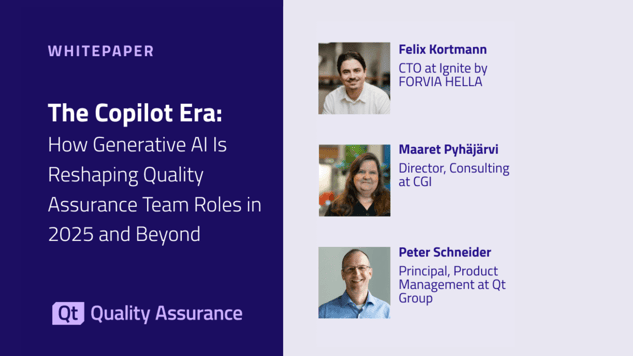
This blog is part of a series authored by leading QA and Test Automation experts: Peter Schneider – Principal, Product Management at Qt Group, Maaret Pyhäjärvi – Director of Consulting at CGI, and Felix Kortmann – CTO at Ignite by FORVIA HELLA. Together, they bring a wealth of experience and unique perspectives on modern testing strategies, automation frameworks, and the role of quality assurance in software development.
What's Next
- Read the blog post:
"It’s a Copilot, Not a Pilot”: How to Use GenAI Responsibly in Software Quality Engineering by Felix Kortmann - Read the whitepaper:
The Copilot Era: How Generative AI Is Reshaping Quality Assurance Team Roles in 2025 and Beyond
- Watch the Panel Discussion:
Maximize the Potential of AI in Quality Assurance featuring the insights by the AI practitioners:
Peter Schneider, Principal, Product Management at Qt Group
Maaret Pyhäjärvi, Director of Consulting at CGI
Felix Kortmann, CTO at Ignite by FORVIA HELLA

Related Articles