The consortium championing the Future Airborne Capability Environment® (FACE) Approach has expanded its allowed membership to organizations from any NATO country, plus Japan and South Korea, in an announcement made at this year’s High Integrity Software Conference (HISC). This builds upon the existing allowed list of Australia, Canada, New Zealand, the United Kingdom, and the United States. As the FACE Approach extends to new programs, so does the systems integrators' need for adaptable and affordable operator interfaces.
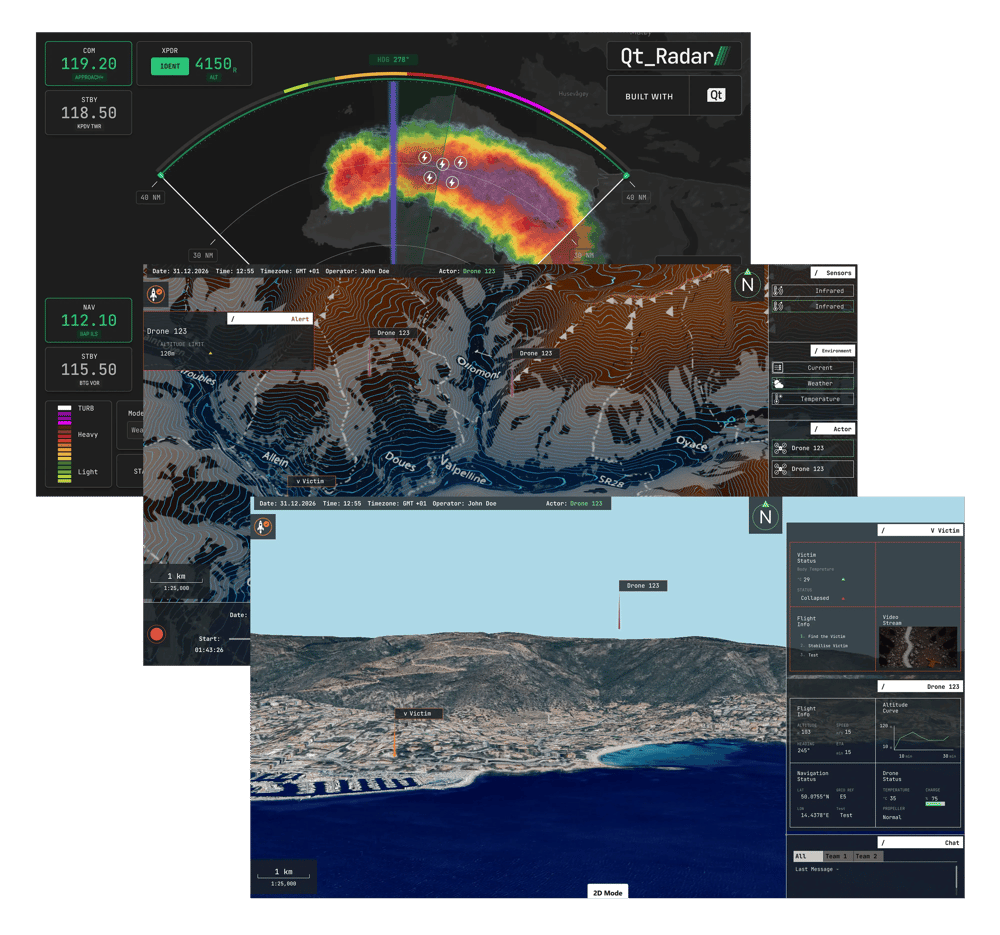
Qt for MOSA, a FACE Conformant edition of Qt Framework, gives teams building HMIs a certified foundation to build upon.
From U.S. airborne roots to allied programs across domains
Established in 2010, the FACE Consortium fosters business processes and vendor-neutral open standards that encourage software portability, reuse, and interoperability in alignment with the Modular Open Systems Approach (MOSA). Initially targeted at military aviation, the FACE Approach has since been more broadly applied to software systems development in ground vehicles, shipboard systems, and other applications. Eligible organizations can join at Principal, Sponsor, or Associate levels to directly influence FACE Consortium decisions and the FACE Technical Standard itself.
The eligibility expansion will help us build a broader international community in the Consortium, said Alicia Taylor, FACE Consortium Director at The Open Group.
Kirk Avery, Senior Fellow at Lockheed Martin and FACE Steering Committee Chair, called it "a defining moment for our organization."
Why this matters to software teams
Allied programs are increasingly called to integrate diverse components from varied suppliers in order to meet complex operating requirements. The difficulty of such integration is a key factor leading to cost and schedule overruns. Taking a common and structured approach to systems integration, now shaped by a wider international community, gives governments and systems integrators a powerful tool to address these cost and schedule pressures.
The difficulty of integration is a key factor leading to cost and schedule overruns.
Operator interfaces are an essential component of most practical systems. It’s imperative that these interfaces unlock the full capability of the mission and sensor systems they power. Qt for MOSA and the FACE Approach enables rich and responsive interfaces to be built, while also being adaptable and affordable, which allows adoption at a lower cost.
Qt Group in Aerospace and Defense
Qt for MOSA: a FACE Conformant starting point for HMI components
Qt for MOSA is an edition of the Qt Framework conformant with the FACE Technical Standard, Edition 3.2, in the General-Purpose Profile. It is registered as a Unit of Conformance (UoC) for the Platform-Specific Services Segment in The Open Group FACE Conformance registry.
What this means in practice:
Qt for MOSA enables rich and responsive interfaces, while being adaptable and affordable.
-
A familiar framework. Qt for MOSA is derived from the full Qt Framework and retains a significant subset of its modules, including Qt Quick, Qt Widgets, Qt Charts, and Qt Quick 3D. Teams with an existing Qt codebase can carry most of their investment forward
-
Less certification work. The reference application and conformance package used for certification of Qt for MOSA are provided as a starting point for user’s own conformance efforts, reducing the overall cost of software certification
-
Standard tooling. Development work is enabled by Qt Creator, Qt Design Studio, and Figma to Qt, as with any Qt project
-
Support across the fielded life. Support and maintenance are included as an essential part of the Qt for MOSA package
Qt Group is headquartered in Finland, a NATO member country, and works with defense customers globally. As adoption of the FACE Approach spreads to allied programs, Qt for MOSA gives teams building HMIs a conformant base to build on from day one.