Jun 23, 2026
Comments
Qt Bridges aim to bring Qt’s UI framework capabilities to commonly used programming languages, like C#, in a way that is familiar to developers using these languages. After the public Beta release, we've continued working on the C# bridge, adding new features and making improvements based on the feedback that we've received. Today we are announcing the release of a new Beta version 0.3.0, including some of these recent additions.
Learn how to start using Qt as your next C# UI framework, try it out, and send us your feedback.
Linux
The workflow for C# + QML app development in Linux is now more stable. To try it out, install the templates package and create a new C# + QML project. An installation of Qt for Linux is required (the C# bridge Linux package does not include a Qt installation), and a QtDir environment variable must be set to the root path of the Qt installation.
$ export QtDir=~/Qt/6.11.1/gcc_64 |
Trying out the Qt Bridge for C# on Linux
Visual Studio Extension
The 0.3.0 Beta release includes a Visual Studio extension that bundles everything needed to get started with C# + QML apps, including a project template and QML IntelliSense. It can be installed directly in the VS Extension Manager, or downloaded from the Visual Studio Marketplace.
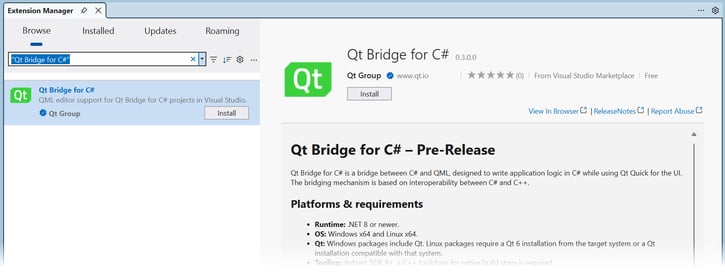
Installing the Qt Bridge for C# extension in Visual Studio
What’s Next?
Try it out and share your feedback with us. Start from the dedicated blog for more details and instructions on how to use Qt as your new C# UI framework.
The next step for our C# bridge is to reach a Technology Preview (TP) state, where we will refine and complement the current offering. Your feedback is very valuable for reaching this milestone, so we hope to hear from you.
Use the Qt Bridges Forum for any related discussions, as well as our bug tracking platform (JIRA) to report issues that you may find once our TP is released.
Future Qt Bridges Releases
C# is part of the first phase of the project; the next language planned for public beta is Rust, so stay tuned for new updates.
Once the bridging for these languages reaches the maturity we are aiming for, we will continue with the second phase.
Blog Topics
Related Articles
Updated Qt Code Review Skills Reduce Token Costs by Up To 75%
Whether you are reviewing Qt Quick or Qt Widget code with Qt’s agentic..
Read Article
Qt Creator 21 - CMake Changes
Here are the new CMake changes in Qt Creator 21: Editor Qt Creator 21..
Read Article
Qt Creator 21 Beta2 released
We are happy to announce the release of Qt Creator 21 Beta2. Please head..
Read Article