Published On
Sep 22, 2025
Read Time
8 mins
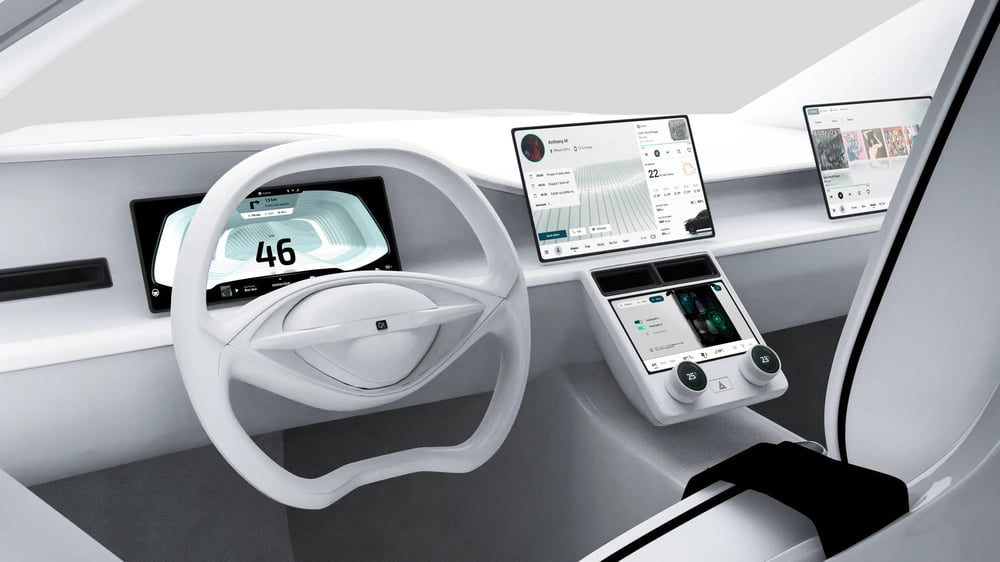
Automotive UX and HMI design must balance aesthetic appeal with functional reliability. Research shows that users often perceive attractive interfaces as easier and safer to use; this phenomenon is known as the aesthetic-usability effect. At the same time, automotive HMIs must present essential vehicle functions clearly and intuitively, minimizing distractions and reducing risks to drivers. Striking this balance in practice means creating visually engaging interfaces while supporting quick recognition, intuitive operation, and easy access to safety features with minimal cognitive load. For OEMs, this is no longer just a design issue but a strategic imperative. To achieve this consistently, manufacturers require a reliable automotive HMI development platform that not only enables these design goals but, importantly, provides a foundation for future innovations and allows the addition of new functions or adaptation to new safety requirements.
Building User Interfaces in Modern Vehicles
Automotive HMIs serve as the central hub for user experience in modern vehicles, managing how drivers and passengers interact with their systems. Within these HMIs are user interface (UI) applications, which consist of various UI elements such as widgets, charts, interaction areas, and views. These elements work together on one or multiple screens to provide users with the information they need to perform different tasks simultaneously. Generally, the internal structure, visual layout, and logic flow of UI applications are unique and significantly different from those of other types of visual software, such as computer-generated imagery (CGI) or video games. As such, their proper and efficient management requires dedicated tooling.
The rich features and services that enter a UI application need a development environment that provides generic functionality and resources that designers and engineers can use as a foundation for creating UI applications. A UI framework offers a creative environment for UI designers and backend developers alike to realize their product vision to the full extent.
On the design side, it includes content authoring tools, asset libraries, configurable graphics pipelines and visual effects, real-time preview and testing on emulators, and much more to devise the end product's user experience. For developers, it offers reference code and applications, APIs, compilers, profilers, code toolsets, libraries, and support for connectivity protocols that turn designs and prototypes into fully functional, future-proof UI applications.
A comprehensive UI framework that covers all stages of software development reduces the workload for designers and developers when implementing their ideas. They are less burdened by complex administrative tasks and error-prone routines, enabling them to concentrate on what truly matters—the ultimate user experience.
Get the Comprehensive Guide on UI Design
Software-Defined Vehicles Need Software-Defined Leaders
A strategic playbook for established automotive OEMs tired of coping with complexity and ready to lead with a software-first mindset. Take ownership of your architecture to eliminate complexity at its source.
Why an Automotive HMI Framework is a Strategic Enabler
Automakers manage multiple brands and configurations, each with a unique identity. The digital interface is essential for establishing this identity and requires customization to differentiate each brand. A modular automotive HMI framework offers:
- Adaptability to different brands, design styles, and hardware types.
- Configurable UI elements and code reuse across operating systems (e.g., QNX, Linux, Android).
- Support for a wide range of hardware, from limited CPU/GPU in entry-level vehicles to high-performance CPUs/GPUs in premium, flagship models.
These capabilities are significant business advantages in speed and time to market, preventing developers from starting over each time and thus streamlining development across projects.
Additionally, integrating various technology stacks, particularly when dealing with legacy systems, is a known challenge in the sector, which requires strong abstraction layers and middleware. Within the automotive HMI framework as the foundation, the UI framework can serve as middleware, which is an intermediary/compatibility layer between the operating systems and applications, facilitating communication and data management. It simplifies the complexities of different hardware and operating systems, and provides cross-platform development interfaces for accessing resources (e.g., file systems, connectivity, IO/sensors) or any systems and pre-built components for common tasks. By enabling cross-platform development, developers can code once and deploy on many platforms, saving businesses material and resources while maximizing return on investment (ROI) in software.
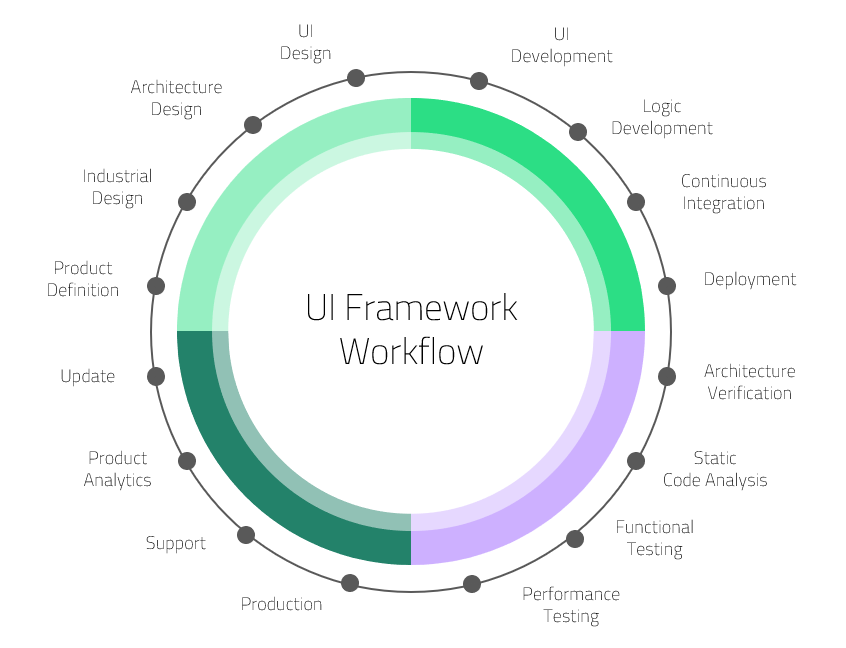
Quick project delivery and cost-effectiveness are top priorities for automotive executives. To enhance development efficiency, effective collaboration among stakeholders, including test engineers, software architects, UI/UX designers, 2D/3D technical architects, and developers, is also essential. The UI framework helps prevent misalignments, delays, and rework by providing dedicated solutions for each stage of the software development process, all built on a single codebase. The framework breaks down silos, and such an end-to-end approach enables automotive OEMs to establish an effective software-first approach, in which the UX is not designed in isolation but incorporated instead with both software capabilities and hardware constraints, reducing mismatches between what the interface promises and what the physical system can deliver.
Watch On-Demand Webinar: Insights for the Software-Defined Vehicle era
Just as a house requires a solid foundation, the automotive HMI framework, as the base for building a vehicle's digital experience, must be robust but adaptable and scalable to support modern automotive demands. As Harman's HMI lead highlighted in his speech at Qt World Summit, building a platform that supports dozens of brands and hundreds of configurations demands a framework capable of managing reusable components, dynamic templates, and brand-specific UI assets, all while maintaining consistency and performance. Choosing the right automotive HMI framework would empower innovation, reduce costs, and deliver a seamless, brand-aligned driver experience.
.webp?width=850&name=Qt-Automotive-reardisplay-01%20(1).webp)
Comprehensive Automotive HMI Development for Software-Defined Vehicles
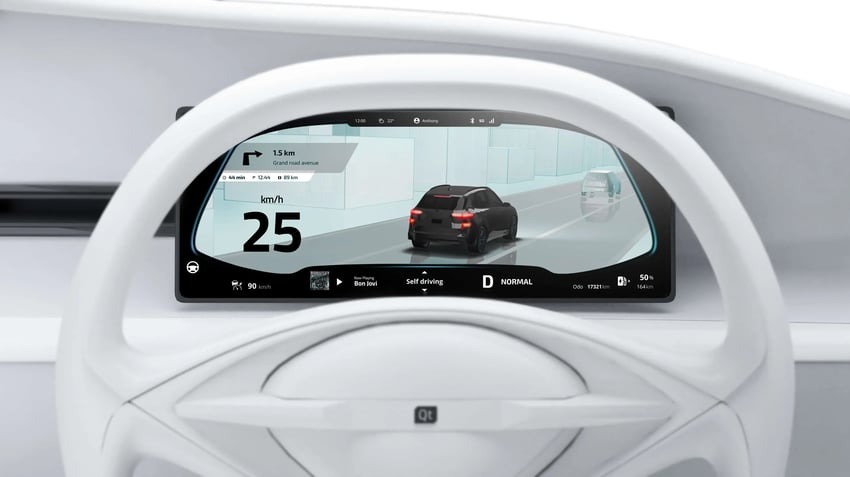
In modern and software-defined vehicles (SDVs), UI/driver-facing applications increasingly use real-time vehicle and sensor data (speed, navigation, ADAS alerts) to provide dynamic warnings and adapt to driving conditions. Features are becoming more software-driven, with Over-the-Air (OTA) updates employed widely to deliver new functionality or fixes, reducing the need for physical recall actions. As a result, automotive HMIs are evolving from static displays into systems more deeply tied to vehicle state, responsive to environment, driver behaviour, and safety signals. This growing complexity further underscores the need for a purpose-built framework specifically for the vehicle environment, with functional safety and compliance in mind, such as Qt Framework.
From Android Automotive to QNX, automotive-grade Linux, Integrity, and more, Qt unifies the HMI development experience under a single framework. This enables automotive OEMs to have greater control and customization over essential components of the connected car infrastructure. Qt's cross-platform capabilities additionally allow for the reuse of visual assets and UI elements across various devices, both in-car (instrument clusters, IVI systems, HUDs) and portable (phones, wearables, PCs), ensuring a consistent branded user experience.
Qt HMI solutions provide a range of high-quality, ready-made, and standardized components, including menus, widgets, animations, and visual effects. But beyond just UI creation, Qt provides end-to-end tools to the automotive HMI lifecycle: design, development, testing, and deployment. By sharing the same codebase across teams, Qt fosters collaborative teamwork and increases productivity. Qt ensures one source of truth, minimizes dependency issues, and simplifies large-scale refactoring. Qt Framework further lets companies define the entire platform's middleware, empowering broad support for automotive functionality, third-party services, and advanced graphics while delivering a native user experience on any target.
In addition, Qt Group's Software Quality Solutions go beyond mere user interface testing to ensure overall compliance with coding guidelines by integrating static code analysis, architecture verification, and code coverage tools that help detect violations of industry standards such as ISO 26262, prevent software erosion, and maintain long-term software integrity in safety-critical automotive systems. Moreover, Qt Safe Renderer helps meet the functional safety requirements essential for the instrument cluster, further solidifying Qt Group as a trusted partner in automotive HMI development.
Read More: World-Class UX is Built on Quality and Goes Beyond UI
Engineering Scalable Automotive Software Platform
Many OEMs are now seeking more control over their automotive software stacks, reducing reliance on Tier 1 suppliers and unlocking strategic advantages. Owning the complete software stack allows OEMs to continuously update user interfaces and user experiences, leverage user data for ongoing enhancements, facilitate seamless connectivity within the vehicle's cockpit, and improve maintenance capabilities. An instance is Hyundai's example of developing their Connected Car OS and defining platform policies, highlighted in this speech at Qt World Summit. By controlling the platform, Hyundai could implement app templates, reusable UI components, and a standardized API layer. This level of ownership over the automotive software stack accelerates time-to-market and enables continuous improvement. Hyundai's case also exemplifies key characteristics of SDVs, including software-driven functionality, modular architecture, continuous updates, cross-brand standardization, and a strong focus on UX.
These characteristics demand a scalable automotive software platform anchored in a centralized architecture. A well-defined platform engineering strategy, with the UI framework serving as the middleware, aligns well with this need. The strategy offers a structured approach to software development with standardized tools, templates, APIs, and best practices. This streamlines development, reduces complexity, and allows teams to deploy cutting-edge features efficiently.
Dive Deeper into how to own Your Automotive Software Stack and why
In conclusion, adopting an automotive HMI framework like Qt offers a strategic advantage for OEMs aiming to deliver sophisticated, user-friendly, and safety-compliant in-car experiences. As vehicles evolve into software-defined platforms, Qt provides the stability, flexibility, and long-term support needed to meet the demands of modern automotive UI design—without compromise or unnecessary complexity.
Explore: Qt for Automotive HMI Development in Software-Defined Vehicles

-webp.webp?width=500&name=Multi-panel%20(1)-webp.webp)