Qt BRIDGES
UIs with Various Backend Languages
Qt Bridges is a future bridging technology in the making. It will enable a single front-end implementation to be used in any industry, on any device, and with a variety of languages.
What Is Qt Bridges?
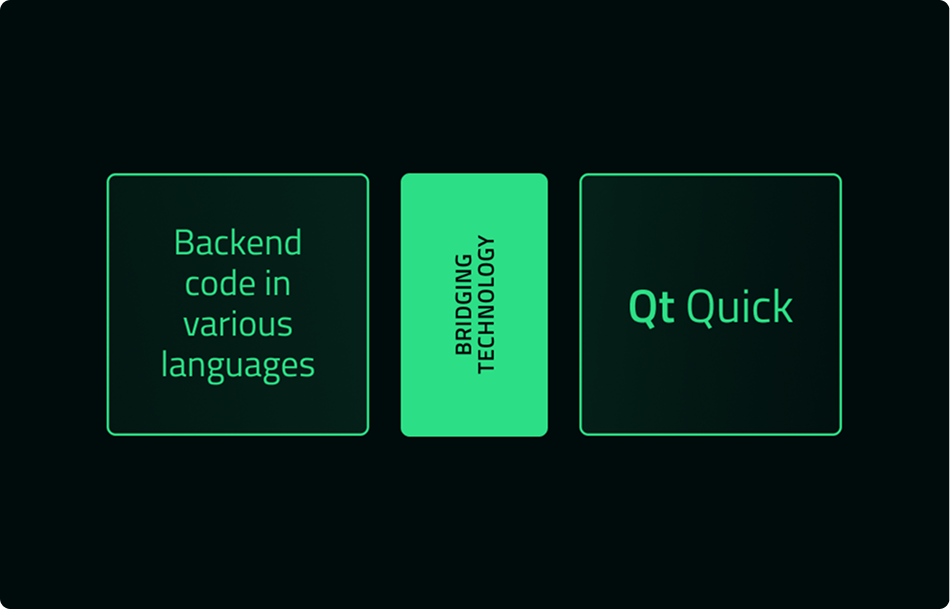
Qt Bridges is a future technology in the making. It will enable QML and Qt Quick to be used as the front-end with various backend languages. This is not a “yet another binding”; it aims to allow a single front-end implementation across platforms and languages. Currently in early access and beta phases with the initially supported backend languages, we’re looking forward to hearing your feedback!
QT BRIDGES PLANS ANNOUNCED
Expansion to a Technology-Agnostic Ecosystem
In May 2025, Qt Group announced a significant expansion of its ecosystem, aiming to make Qt compatible with a wide range of programming languages. "Our ethos with Qt and cross-platform development has always been ‘build it once, use it everywhere’", says Juhapekka Niemi, Senior Vice President, Product Management at Qt Group.
"You can build the modern UX of your dreams on top of any foundation imaginable, and you never have to duplicate the work. That’s where the real value is." The goal of Qt Bridges is to power all software development needs across every device and industry, to speed up and simplify UI/UX development for software applications. The work on this next phase of Qt is under way.
Available Qt Bridges Languages
We are working on taking the initial Qt Bridges proof of concept to a state for you to give it a try each backend language at a time. The first 5 initial languages have been in an early access stage since 2025, and we move them to public beta as we see them in a good shape for you to explore more - C# being the first in beta, soon followed by Rust. Your feedback especially on the languages in beta are most welcome - please engage with us in Qt Forum!
Beta: C#
A bridging technology that provides a feature-rich, cross-platform UI framework for C# applications. Currently available for Windows (x64) and Linux (x86_64).
Soon in Beta: Rust
A bridging technology to bring a rich frontend framework for Rust applications. More coming soon!
Early Access: Python, Swift, and Java/Kotlin
Qt Bridges for the backend languages in earlier phases to build modern, cross-platform, Qt-powered UIs.
HELP US MAKE QT BRIDGES BETTER
Be the First to Hear Project News
If you have interest in bridging a new language to use Qt Quick for UI, sign up on our mailing list to be among the first to hear news about our project. No spam, we promise!
We'll keep you in the loop about how this upcoming technology evolves and we may invite you to give us your feedback or try it out; your comments, observations, and insights will be highly appreciated by the Qt development team.
Get in Contact and Learn More
Forum for Qt Bridges
Get in contact with our developers, join discussions related to the different Qt Bridges languages, get peer help, share your discoveries, and learn what’s new.
Documentation
Qt Bridges documentation is still in the making, however, you can already access early documentation with guidelines to help you get started.
Latest Blogs on Qt Bridges
A Cross-Platform C# UI Framework via Qt’s Bridging Technology
Every C# UI framework comes with a familiar pattern: Windows-first, Li...
Qt Bridges: Public Beta for the C# Bridge Is Out!
Qt Bridges is a project we have been developing since 2025 to bring Qt...
Qt Bridges: Modernizing Software Design and Development
During Qt World Summit ‘25, we announced our new initiative, Qt Bridge...
More on Qt’s UI Capabilities
Qt Framework’s comprehensive set of cross-platform UI libraries and APIs take away your routines from UI controls to 2D to 3D graphics.
More on the QML Language
Qt’s UI language, QML, is a declarative, memory-safe language that allows a clear separation of the frontend and backend.
Get Started with Qt Bridges
Try out especially the C# bridge in BETA and help us make it the best it can be!